Pardon me for trying to grab your attention à la The National Inquirer or some click-bait headline. But when I came across these images in the Stuart A. Rose Library, I was stunned and wanted to share them.
Ever since I first laid eyes on the tower next to the dam in Lullwater Preserve, more than thirty years ago, I have wondered what it looked like in its glory days. Below is its current condition.

See here for a closer view. Note the vegetation on the far bank. Behind it and to the right of what you can see in the photo rises the Atlanta VA Hospital along with its parking decks.
Walter Candler, Emory College Class of 1907, was the second-youngest son of Coca-Cola founder and Emory benefactor Asa Griggs Candler. When Walter began developing his 183-acre estate in 1925, DeKalb County had not fully developed its electrical grid, and county power did not extend to the house, which Candler occupied in 1926. He thus had to generate his own power with the help of the dam that he built across the South Fork of Peachtree Creek, shown above. Machinery within the tower cranked out electricity. The generating equipment has long since been removed, and the tower has fallen to rack and ruin.
Below is what it looked like when newly built.

Note the bridge over the dam, which was removed in the early 1990s because it had become hazardous. In the distance, where the VA Hospital now stands, a horse pasture spreads toward Clairmont Road. And there are two of Candler’s horses!
Most magnificently, the pointed roof sports clock faces—in case you got to wondering what time it was while fishing the stream.
The photographer who took the old photo, possibly in about 1930, turned around and then took the photo below. The dam is now to the photographer’s back.

The wooden bridge in the photo straddled a stream that flowed in from about where the road vanishes in the distance. That stream is now known as Earnest Richardson Creek, after the long-time caretaker of Candler’s estate. Beyond the stream lies a low pasture, and beyond it rises an embankment topped by a white fence. Farther still rises a hillside. Lullwater House, the English Tudor-style home that Candler built, now the home of Emory presidents since 1963, stands at the top of the high hill whose base rises up to the right of the photo.
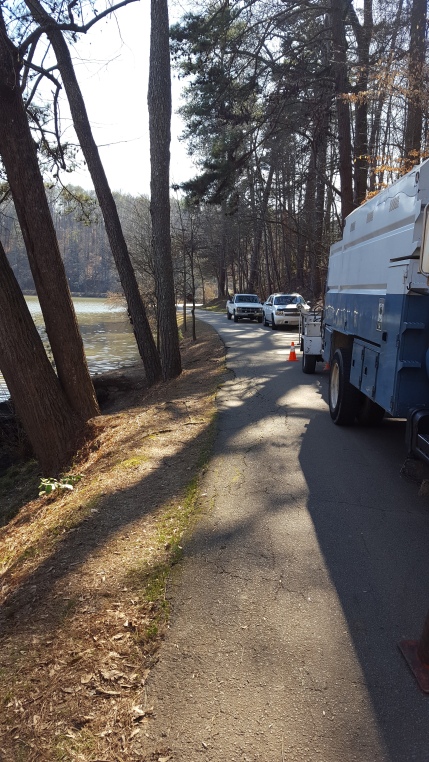
At some point, Candler decided to dam Richardson Creek at about the lower left corner of the photo to create a lake that would fill in that far pasture. Below is the same view, taken in January 2017. The vehicles belong to an Emory Campus Services crew removing fallen trees near the dam.
The photo below shows the dam that created the lake.
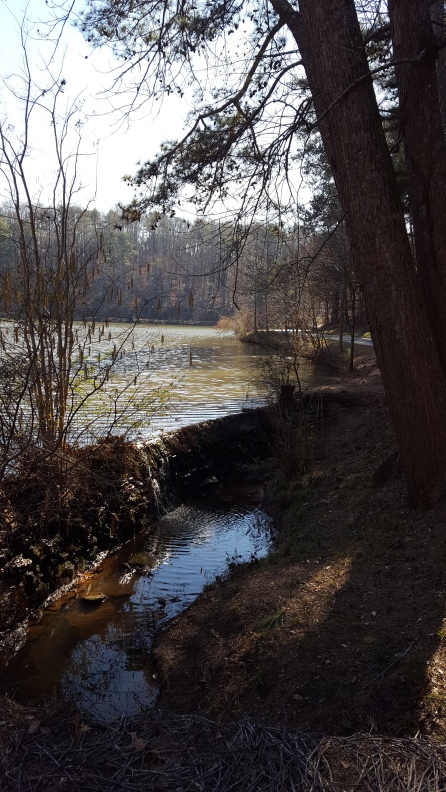
Note that the far bank of the lake still is topped by the dirt road that was there in the earlier photo, but the distant hill is entirely wooded. Those woods are part of the “Emory Forest” whose preservation is part of the long-term sustainability plan for the campus.
Amazing what a difference 90 years can make.
Gary Hauk


 Emory Historian's Blog