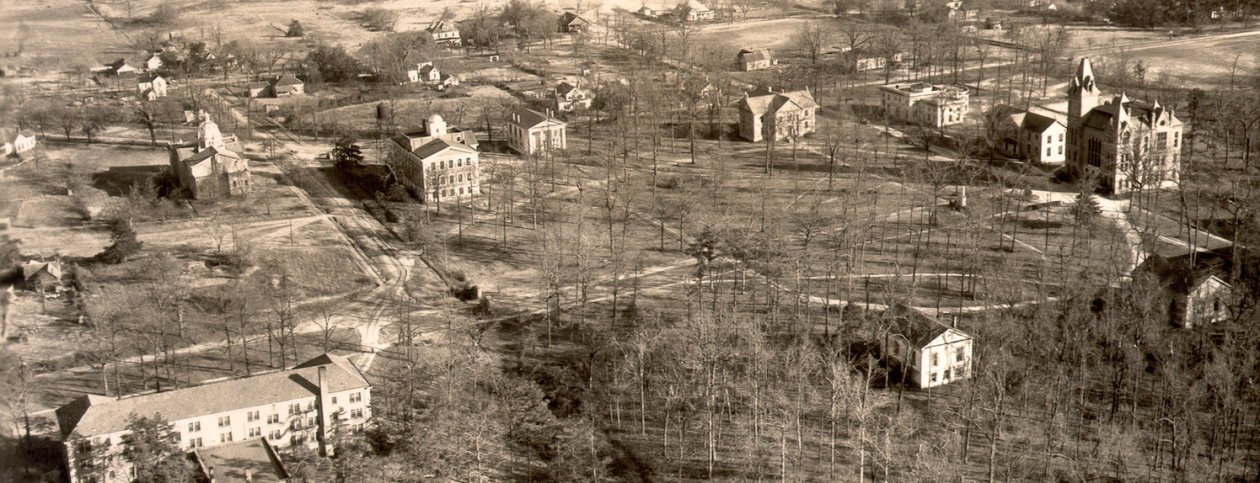
Lone gal among Oxford guys

Flipping through a folder of archived photographs in the Rose Library, I was surprised to see a young woman in a group identified as the Oxford graduating class of 1950. This was three years before the board of trustees agreed to admit women to Emory College as residential students, and several years before the first female residential student showed up at Oxford.

The only woman among 25 men, she stands in the center of the front row looking demure under her sun hat but confident in the appropriateness of her place. She knows she belongs there. Who could she be?

Screen Shot 2017-05-31 at 8.20.37 AM
Emory-at-Oxford graduating class, June 3, 1950, standing in front of Old Church. (Emory-at-Oxford was renamed Oxford College of Emory University in 1964.) Photo courtesy of Rose Library, Emory University.

I turned to my 91-year-old friend Harold Wilson Mann to see whether he might remember her. After earning three degrees from Emory, he taught history and directed the glee club at Oxford in the 1950s. His stint there didn’t begin, though, until a couple of years after this photo, so he had not crossed paths with the mystery student.

University archivist John Bence told me that Oxford course catalogs at that time listed students in the two-year college curriculum. Digitized and available online, the catalog published in March 1950 includes a “register of students” with three women’s names: Dorothy MeGahee, a second-year student, and Virginia C. Davis and Dorothy J. Dodson, both first-year students. MeGahee was listed as hailing from Covington, Davis from Toccoa, and Dodson from Austell. So perhaps the graduating woman in 1950 was Dorothy MeGahee.

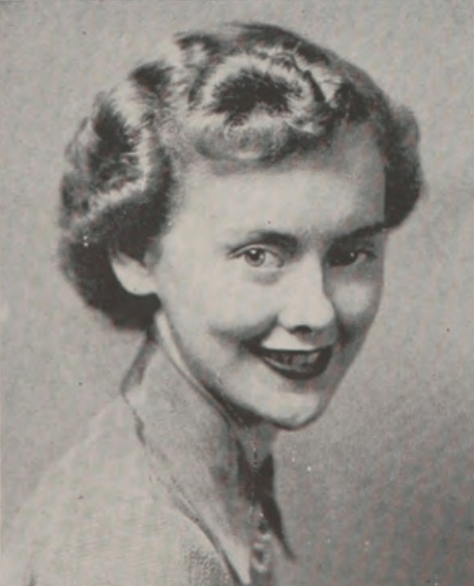
Not only the catalogs but also the old Oxford yearbooks are now digitized and online. Sure enough, in the 1950 Memory, I found her. “Dot,” she was called.
Screen Shot 2017-05-31 at 7.38.00 AM
Dorothy “Dot” MeGahee in the 1950 Memory yearbook of Oxford.

She had quite the full dance card: editor-in-chief of the yearbook, vice president of Phi Epsilon Upsilon literary society (the Few Society), officer of the International Relations Club, and president of the Coed Club–whose membership included all three of the female students.

Screen Shot 2017-05-31 at 7.44.54 AM
Officers (and the only available members) of the Coed Club at Oxford in 1950: Virginia Davis, left, Dorothy MeGahee, center, and Dorothy Dodson.

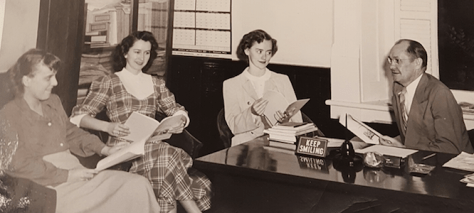
A further chapter in these women’s story turned up in the archives. As I looked through more photos, I happened on one of the three of them with Dean Virgil Eady.
Screen Shot 2017-05-31 at 8.18.59 AM
Dorothy Dodson (left), Virginia Davis, and Dorothy MeGahee meet with Oxford dean Virgil Y.C. Eady in 1950.

Turning it over, I found the women’s names and hometowns and this text:

Dodson and Davis will be sophomores [in] the coming term. MeGahee graduated in June, 1950, and is now enrolled in the Emory summer school. According to Dean Eady no more coeds will be enrolled at Oxford. The above will be allowed to graduate.

Little did Dean Eady suspect that many more women were on the way.

Dorothy MeGahee went on to graduate magna cum laude from Emory with a degree in nursing and later earned a master’s degree in nursing administration from the Medical College of Georgia. She married her classmate Hamlin Callahan Jr. just after graduating from Emory College and apparently remarried at some point, to a man named Davis. She was working as the supervisor of the Warm Springs Foundation Hospital in Warm Springs, Ga., when cancer claimed her. She died at the young age of 50, in 1982, and is buried next to her parents and brother in her hometown of Covington.

Gary S. Hauk

Thanks to University archivist John Bence for locating the digitized 1950 course catalog and 1950 Memory yearbook.
Emory doctors in World War I

Emory alumnus Ren Davis has a personal connection to one of the more remarkable stories of Emory University’s service to the nation. He is the grandson of Edward Campbell Davis, MD, who a century ago was serving as a professor in the school of medicine in the relatively new Emory University, when the United States entered World War I. Dr. Davis also was co-founder, with Dr. Luther Fischer, of the Davis-Fischer Sanatorium, which later became Crawford Long Hospital and later still Emory University Hospital Midtown.

Ren has published the compelling story of his grandfather’s response to the call to serve. You can read it here, in the Saporta Report, the excellent online journal created by longtime Atlanta business reporter Maria Saporta.

The Stuart A. Rose Manuscript, Archives, and Rare Book Library holds copies of the History of the Emory Unit: Base Hospital 43, U.S. Army, American Expeditionary Forces. Author Joel Chandler Harris, whose papers also are housed in the Rose Library, had a hand in editing and publishing the book.

My thanks to Ren for allowing me to point my blog readers to his story.

Gary Hauk

Emory from the Sky

Alumni returning to Emory often exclaim—sometimes lamenting, other times just flabbergasted—how the campus has changed since their student days.

No kidding!

In the past fourteen years alone, the University has built nine residence halls, two new theology buildings, three medical education or research buildings, one for public health, a new home for admissions and the bookstore, a new psychology building, new sorority lodges, and at Oxford a new science building, new library, and new dining hall. Not to overlook sundry smaller projects like the traffic circle and new entrance in Emory Village.

Nothing, however, gives a sense of the changing landscape like a view from the sky.

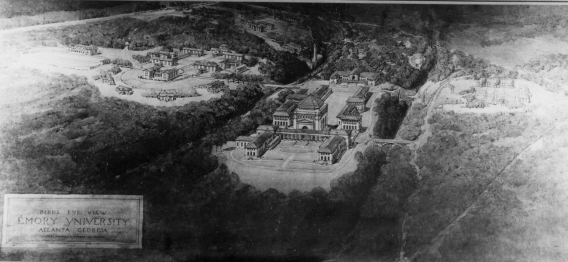
While we don’t have an aerial photo of Druid Hills before the Atlanta campus was built, we do have an architect’s vision of the campus as it nestled into what had been “the old Guess place.”

The original 75 acres given by Asa Candler straddled two hills divided by streams and covered with pine woods. To turn this rural landscape on the edge of Atlanta into a university campus, the trustees hired the inimitable Beaux Arts architect Henry Hornbostel. He found the hills and pines of the Emory terrain reminiscent of Tuscany and hit upon an Italian neo-Renaissance look, with marble façades, red-tile roofs, broad eaves, and Roman arches for doors and windows.

Screen Shot 2017-04-26 at 1.33.17 PM
Henry Hornbostel’s campus plan; photo from Stuart A. Rose Library

Using bridges to cross the streams and connect the hills, he laid out the academic heart of the campus on a hill that is now the Quadrangle, with a farther hill set off for living, dining, athletics, worship, and other social activities. While the design was too expensive to implement fully, the first buildings, opened in 1916, included the Theology Building and Law Building (lower center of the photo) and the Physics Building (now Callaway Center South), to the left of the tall tower, which was never attempted. The sole residence hall designed by Hornbostel and still standing is Dobbs Hall, shown in this design in the center of the semicircle of buildings to the left. Emory Village would grow up at the V shown at the lower edge of the photo.

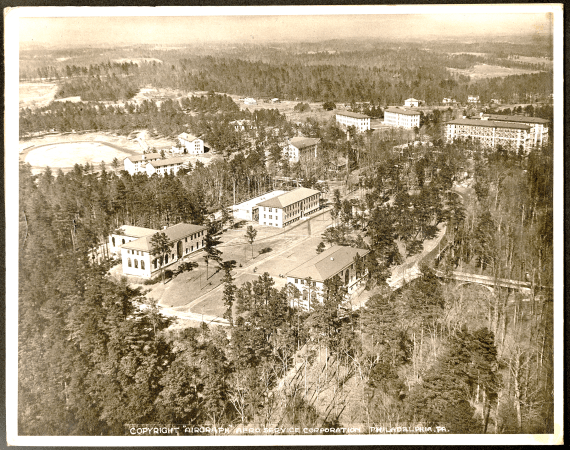
The photo below, probably taken in 1922, shows why William Dillingham 55C 56G, professor emeritus of English, remarked about his student days, “When I came to Emory, it was a small school in a forest.” The campus had been even more remote three decades earlier, as the woods and fields of DeKalb County stretched north and east of Druid Hills.

Screen Shot 2017-04-26 at 1.39.31 PM
Emory University, circa 1922; photo from Stuart A. Rose Library


The two buildings swathed in construction scaffolding in the upper right corner are Wesley Memorial Hospital, later renamed Emory University Hospital. These buildings, completed in 1922, replaced the hospital’s original home in downtown Atlanta.

Two campus landmarks help to date precisely the photo below—one landmark by its presence, the other by its absence.

Screen Shot 2017-04-26 at 1.44.24 PM
Emory, 1932; photo from Stuart A. Rose Library

Glenn Memorial Church, shown in the lower center of the photo, was constructed on the Emory campus in 1931, the gift of board chair Charles Howard Candler Sr. 1898C 1902M and his wife, Flora Glenn Candler. What’s missing from the photo is the water tower that was installed in 1933 near where the tall boiler smokestack rises above the athletic fields. (See blog post of October 3, 2016.)

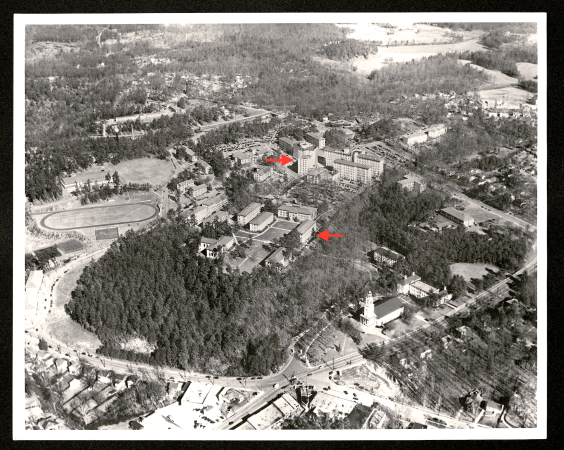
The end of World War II and the benefits of the GI Bill sparked an unprecedented growth in the student body and faculty at Emory. To accommodate all the new people, the University built in a frenzy while using trailers and wooden barracks for temporary space. The forest began to give way. The History Building (1951, now Bowden Hall) in the center of the photo below and the Woodruff Memorial Research Building (1952) to the left of the hospital help date this photo. Missing is the Administration Building (1955), which would close off the western end of the Quadrangle, still very wooded in the lower center of the photo. Note the water tower rising from the trees above the athletic fields.

Screen Shot 2017-04-26 at 1.55.56 PM
Emory campus, circa 1952-55; photo from Stuart A. Rose Library


As the Baby Boom hit Emory in the 1960s, the campus began to sprawl. Cox Hall (1960) appears in the photo below, above the hospital buildings; off to the right rise the new buildings of the Centers for Disease Control, which moved to Clifton Road in the 1950s. Missing from the photo is Robert W. Woodruff Library, which in 1969 would take another large bite out of the woods toward the lower-left corner of the photo.

Screen Shot 2017-04-26 at 2.12.47 PM
Emory campus, 1963; photo from Stuart A. Rose Library

Later aerial photos would show even more dramatic growth—as well as the loss of some of the buildings shown above. Thus—lament and astonishment!

Gary S. Hauk