In 1985, Emory added a John Portman-designed wing to the west façade of the 1927-vintage dining hall and auditorium, which stood on one of the highest points of the campus. An earlier addition to the east side of the dining hall, dedicated in 1950, had led to the renaming of the structure as the Alumni Memorial University Center, or AMUC. Rechristened at its dedication in 1986 as the Dobbs University Center, in honor of its principal donor, R. Howard Dobbs Jr. 27C, the entirety of the new student-life center quickly gained the nickname of the DUC.
The year after the DUC opened, Emory observed its sesquicentennial, and part of the celebration of that milestone included the burial of a time capsule near the DUC. I commented on this time capsule in an earlier blog. Plans call for the time capsule to be opened in 2036, at the bicentennial, but no one said anything about digging it up before then.
With the demolition of the DUC this summer to make way for a new Campus Life Center (CLC)–which you can see in a drone’s-eye fly-through–construction crews had to dig up the time capsule and set it aside for reburial later.
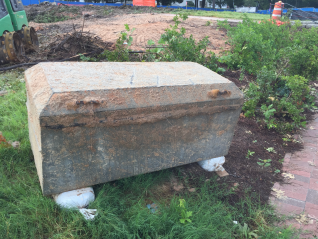
Al Herzog, the Emory manager overseeing demolition of the DUC and construction of the CLC, sent me this photo of the time capsule last week to reassure me that it is safely in the hands of folks in Campus Life.
The exhumed time capsule, still sealed until 2036.Explanatory plaque that had been set into the ground above the buried time capsule.
Al also sent an aerial view of the construction site, which shows the vacant area where the DUC once stood. The time capsule had been buried near the large bush in the lower right corner. In the back stands the old AMUC, with its 1927 façade covered by plywood for protection against construction debris. Plans call for restoring the AMUC as a stand-alone building.
Time capsule was buried near the large shrub just above the truck with the white cab, lower right.
Some say a ghost haunts the stucco-covered building behind the Winship Cancer Institute. Certainly history lingers there. Nestled under the trees along Uppergate Drive, this structure, now dwarfed by Winship and a parking deck, once was home to Arthur Tufts and his family.
The Tufts House stands beside a parking deck (left) and the Winship Cancer Institute (rear) along Uppergate Drive.
The Atlanta-born Tufts, a graduate of Georgia Tech, was a contractor who supervised the construction of Camp Gordon near Atlanta. He made his fortune, however, by earning the gratitude and confidence of Asa Candler Sr. and the Coca-Cola Company in constructing the Candler Building in Atlanta, the Candler Building on 42nd Street in Manhattan, and other edifices commissioned by Candler for his business empire. Candler, who always wanted things done right, not only gave the first million dollars and seventy-five acres for the new university next to his Druid Hills suburb; he also enlisted this trusted builder to develop the new campus.
Arthur Tufts, around 1918. Photo courtesy of the Stuart A. Rose Manuscript, Archives, and Rare Book Library, Emory University.
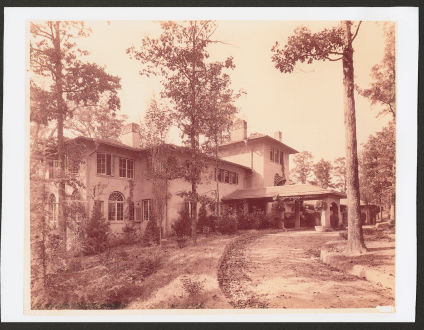
To be close to the construction, Tufts bought a 25-acre tract along Clifton Road and built his house there in 1917. Henry Hornbostel, the architect who designed the university’s first marble-clad concrete buildings, also designed the Tufts house to be built of concrete, but covered with pink stucco. Tufts called the place Woodland.
Woodland, the home of Arthur Tufts and his family, as it appeared around 1920. Courtesy of Stuart A. Rose Library, Emory University.
The driveway leading to the house had two gates—an “upper gate” (perhaps because it was farther north, or farther up the road from the campus) and a “lower gate”—hence, names that still survive in Uppergate Drive and the Lowergate Parking Deck.
The Tufts family garden, part of the 25-acre tract known as Woodland, has long since given way to clinics and parking structures. Courtesy of the Rose Library, Emory University.
Described by the late George P. Cuttino in his Dooley’s Book: A Guide to the Emory Campus, the house “was entered through a porte-cochère, and it was built for gracious family living. Included on the first floor were a kitchen, servants’ rooms, a columned sun room, and a living room. Sleeping porches and bedrooms were on the other two floors.” Tufts and his wife, Jeannie Tufts, had four children, one of whom died in infancy.
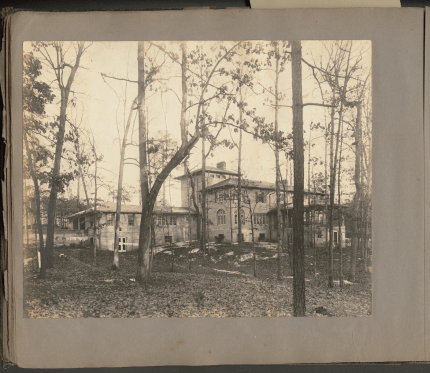
A rear view of Woodland suggests the rural character of the area at the time of the photo, around 1918. Courtesy of the Rose Library, Emory University.
From this proximity to the campus, Tufts supervised the construction of Emory until his death from pneumonia in 1920 at the age of forty. Jeannie Tufts continued living at Woodland until 1940, when she moved into a smaller house across Ridgewood Drive. Emory bought Woodland in 1943. (Jeannie Tufts died in 1975.)
Renamed Uppergate House, the Arthur Tufts home served for a time as a dormitory for nursing students. In the late 1960s and early 1970s, Uppergate House housed the Biomedical Data Processing and Analysis Center and the burgeoning university computing center. A former director of the computing center has told the story of working alone in the house late at night when a ghostly woman appeared out of nowhere in search of her son—and then disappeared. Now painted white, the Tufts House currently is home to the Emory University Psychoanalytic Institute.



 Emory Historian's Blog