Emory and the Confederacy

The past few years have brought intense controversy over questions about the legacy of the Confederate States of America—more than 150 years after the end of the Civil War. From Baltimore to New Orleans, from Charleston to Memphis, statues and flags have come down. In Georgia, the world’s largest bas relief, depicting Confederate leaders on the side of Stone Mountain, looms at the center of a debate about whether to chisel it into oblivion. Colleges and universities founded before the Civil War have wrestled with what to do about campus monuments to slave owners or the Lost Cause.

At Emory, too, the question has been raised—what monuments to the Confederacy do we have? The answer, I believe, is none. Emory has little in the way of sculpture of any kind on either the Oxford or the Atlanta campus, and nothing that would constitute a monument or memorial to the Confederacy.

The Few Monument—an obelisk standing in front of Seney Hall on the Oxford campus—was erected in 1849 to honor Ignatius Alphonso Few, the first president of Emory College. Dedicated by Few’s fellow Freemasons four years after his death from tuberculosis, the monument long preceded Southern secession.

20170830_160343
The Few Monument on a rainy day in Oxford, Georgia.

Another obelisk stands about a hundred yards west of the Oxford College gym, in a small cemetery where at least thirty-two Confederate soldiers lie buried. They apparently died in the makeshift hospitals that occupied Emory College buildings after the Battle of Atlanta. The obelisk has no images or words other than the simple declaration that these were “Our Soldiers.” Federal soldiers who died in the same hospitals lie a mile away, across town, in a common grave in the town cemetery.

20170830_161020
Monument to the Confederate dead in the cemetery on the Oxford College campus.
20181104_144649
Common grave of Union dead in the Oxford town cemetery.

On the Atlanta campus, the Haygood-Hopkins Gate honors two alumni who became Emory presidents—Atticus Greene Haygood and Isaac Stiles Hopkins, both of the Class of 1859. Haygood was a chaplain in the Confederate army, but the gate, erected in 1937, honors him and Hopkins as educators, not for any Confederate legacy. Haygood left the Emory presidency in 1884 to help develop colleges established for newly freed slaves, and Hopkins left Emory in 1888 to become the first president of Georgia Tech.

Screen Shot 2018-11-20 at 3.26.24 PM
The Haygood-Hopkins Gate at the entrance to the Druid Hills campus.

Yet slavery and the Confederacy do appear in Emory history. All of the antebellum presidents, faculty, and trustees of Emory owned slaves. Many alumni and students fought for the Confederacy, thirty-five of them losing their lives. Three Emory graduates became Confederate generals—Edward L. Thomas, Class of 1846; James P. Sims, Class of 1855; and Reuben W. Carswell, Class of 1856. The sons of two Emory presidents, George Foster Pierce and Alexander Means, both fought in the Army of Northern Virginia. Professor Gustavus Orr, later the state school superintendent of Georgia, organized a Home Guard for Newton County in which he served as a captain, while President James R. Thomas served as a lieutenant.

All of this history has been told. Names on Emory campuses remind us of it. Buildings at both Oxford and Atlanta as well as streets on the Atlanta campus bear the names of antebellum presidents Few, Longstreet, Means, Pierce, and Thomas. More than anything, these names link the modern campus to its roots in Oxford, celebrating the survival of a fledgling college rather than remembering the unlamented demise of a way of life or the defense of that way of life by secession and war.

Yet Emory has honored two staunch supporters of the Confederacy. While Emory recognized them for other, extraordinary achievements, their association with the Confederacy complicates their legacy. The next installment will say more about the first of these two men.

Gary Hauk
A Few pilgrimages to Oxford

Autumn brought an intriguing email out of the blue from a young man named Joshua Daniel Few. A native of Montana, Josh is part of the extensive family that includes a signer of the United States Constitution (William Few Jr. of Georgia), a controversial pre-Revolutionary rebel against British taxation (James Few, hanged by the British after the Battle of Alamance, in North Carolina), a president of Duke University (William Preston Few, buried in Duke Chapel), and someone well known to Emory–Ignatius Alphonso Few, the founding president of the college.

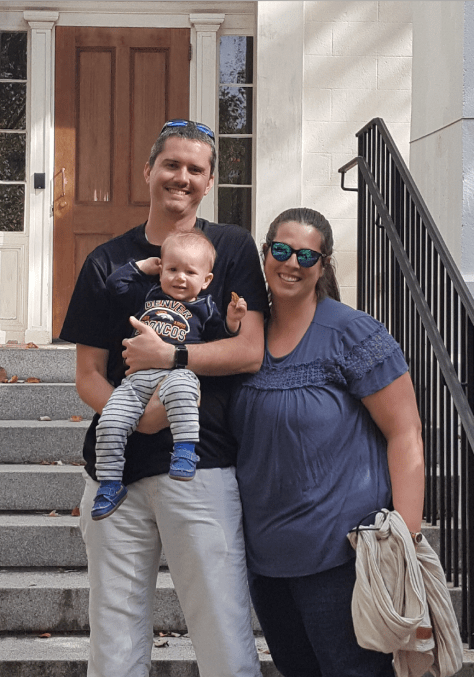
Josh now lives in South Dakota with his wife, Crista (a newly minted physician about to begin her practice), and their 13-month-old son, William James Few–the latest in a long and venerable lineage of William Fews.

As I understand the family tree, Josh is the direct descendant of William Few Sr.’s brother, James Sr., not to be confused with William Sr.’s son James, the one who was hanged. William Sr. was the grandfather of Ignatius Alphonso Few. That makes William Sr. Josh’s great-uncle times eight, and I.A. Few Josh’s first cousin nine times removed. If I have it right.

As the family genealogist, Josh had planned  a week-long pilgrimage to Few family sites all along the East Coast. The capstone would come with a visit to Oxford. Josh kept a blog of their journey, and you can read it here.

Thus, on a beautiful Sunday afternoon in November, my wife, Sara-Haigh, journeyed with me to Oxford to meet up with them. Joe Moon, the Oxford College dean of campus life, joined us on the Oxford Quad for a tour of Few shrines.

First up was Few Hall, one of the two oldest buildings owned by Emory University. Originally the home of one of the two debate societies organized by Emory College students in 1837, Few Hall was constructed in 1851 with funds raised by the society’s members and honors President Few. Renovated and expanded in 2001, the building now includes the Tarbutton Performing Arts Center.

Screen Shot 2018-11-04 at 8.21.45 PM
The Fews examine Few close up.


Screen Shot 2018-11-04 at 8.21.30 PM

A short stroll across the Oxford Quadrangle brought us to the Few Monument, in front of Seney Hall. Dedicated in 1849, ten years after ill health forced President Few to resign, and four years after his death from tuberculosis, the monument was the inspiration of Few’s fellow Freemasons — some 600 of whom showed up for the dedication.

Screen Shot 2018-11-04 at 8.22.11 PM
The youngest Few, William, examines the monument to a distant ancestor.

After a tour of the Quad, including a stop into the library and Candler Hall, we drove down Wesley Street to the house that Ignatius Alphonso Few built in 1836. Since 1889, it has been home to the presidents of Emory College and, after the move of the college to Atlanta in 1919, home to Oxford College deans.

Screen Shot 2018-11-04 at 8.22.34 PM
Gary Hauk, Joe Moon, and the Few family in front of the Dean’s House, the home Ignatius Alphonso Few occupied as president of Emory College from 1836 to 1839.

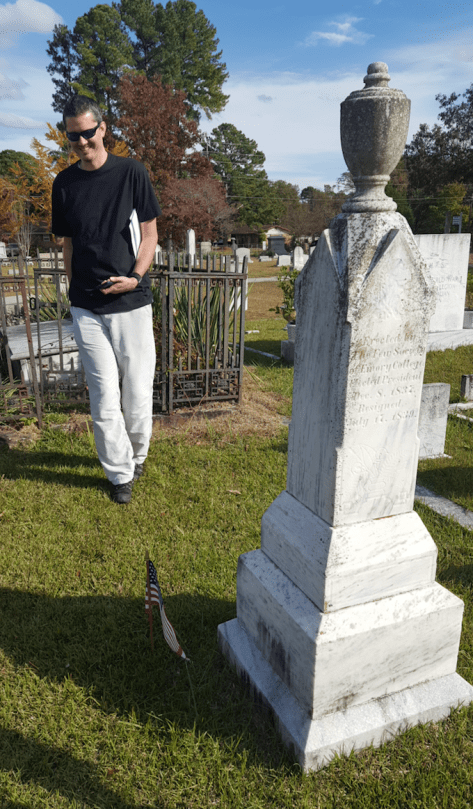
At the opposite end of town from the college campus spreads the old town cemetery. There, among generations of Oxford families, lies the grave of Ignatius Alphonso Few, who spent his last years in Athens, Georgia, before succumbing to tuberculosis. An inscription on his grave marker says that it was “erected by the Few Society of Emory College.”

Screen Shot 2018-11-04 at 8.22.54 PM
At the end of a long pilgrimage to Few sites from Pennsylvania to Georgia, Josh pays homage at the grave of Ignatius Alphonso Few in the historic Oxford Cemetery.

Besides the pleasure of meeting this young family on a beautiful autumn afternoon, it’s no stretch to say that the occasion offered the first opportunity to begin recruiting little William James Few to the Class of 2038. That year will mark the bicentennial of the first classes taught on the Oxford campus.

Many will apply for admission, but let’s assume Few will be chosen.

Gary Hauk