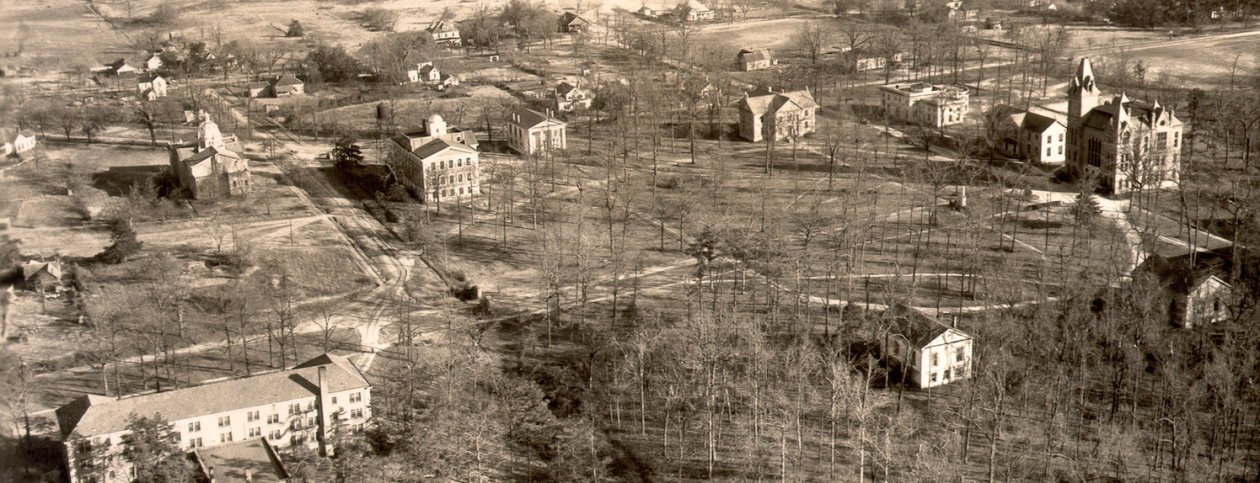
The 1915 birth of a new university named Emory relied heavily on Methodist connections. The first board of trustees of the new university comprised members of the Educational Commission of the Methodist Episcopal Church, South (MECS), and a number of them continued as trustees when a new board was elected in 1916. Even before the university received its charter on January 25, 1915, the theology school of the university began operations in September 1914 at Wesley Memorial Methodist Church, built by the North Georgia Conference of the MECS in downtown Atlanta in 1910. Bishop Warren Candler, former president of Emory College, guided the design and completion of the edifice.
Not far from the church was Wesley Memorial Hospital, which had been established in 1905 by the North Georgia Conference with significant funding from Asa Candler; in 1922 this Methodist-founded hospital moved to the new Druid Hills campus of Emory to become Emory University Hospital. Along with the hospital came a nurses-training program, which later became the Nell Hodgson Woodruff School of Nursing. Another part of the health sciences center at Emory with links to Methodism is the Rollins School of Public Health, established with the support of a family of prominent Georgia Methodists whose patriarch, O. Wayne Rollins, designated his first gift to Emory to the Candler School of Theology.
After the move of Emory College to Atlanta in 1919 to join the professional and graduate schools already growing on the Druid Hills campus, Emory continued its entwinement with Southern Methodism through the first half of the twentieth century. The first three presidents of the university—Harvey Cox, Goodrich White, and Walter Martin—all had roles in local, state, and national Methodism, while two deans of the theology school—William R. Cannon and Mack B . Stokes—were elected bishops of the United Methodist Church in 1968. The first three chairs of the university board of trustees—Asa Candler Sr., Charles Howard Candler Sr., and Henry Bowden Sr., who served for a combined sixty-four years, from 1915 to 1979—all were prominent Methodist lay leaders in Atlanta.
Methodist faculty members in the theology school played critical roles in debates over the reunion of the southern and northern branches of Methodism in 1939 and later played a still more important role in helping the university move toward integration in the late 1950s and early 1960s. One of the arguments in favor of opening the doors to African American students was that the 1952 Discipline of the Methodist Church stated, “There is no place in the Methodist Church for racial discrimination or racial segregation.”
Founded by Methodists who were keen on educating their children through a Methodist lens, Emory nevertheless has always been open to believers (and nonbelievers) of every stripe. Presbyterians and Baptists, while scarce, enrolled in the college during the nineteenth century. Jewish students began enrolling in the late nineteenth century and became a growing presence from the early twentieth century on, after Bishop Candler—the university chancellor from 1915 to 1920—excused the children of Orthodox Rabbi Tobias Geffen from Saturday classes.
In time, Roman Catholics and, later, adherents of the world’s other major religions would come to outnumber Methodists among the student body. The openness of the campus to this religious multiplicity reflects the Methodist tradition of seeking unity within diversity.
John Wesley himself expressed this attitude. He recognized his own fallibility and sought to learn how other traditions practiced holy living, even as he held fast to his belief in the truth of Christianity. In a sermon titled “A Caution Against Bigotry,” Wesley encouraged his followers to support whatever activity advances the love of God in the world, even if that activity is the work of other sects or other religions.
This article of the Methodist creed was tested at Emory in 1997 when controversy erupted over the question whether same-sex commitment ceremonies could be performed in Emory chapels. An employee of Oxford College had requested use of the chapel on that campus for a commitment ceremony with his male partner. The dean of Oxford College initially granted permission but later rescinded it over concerns about the university’s relationship with the church. The Book of Discipline prohibits use of United Methodist churches for same-sex ceremonies and prohibits United Methodist clergy from performing them.
After extensive discussion, the university adopted a chapel policy that relied on Emory’s nondiscrimination policy but also called on the Methodist tradition of respecting the practices of other religions—including the right to perform ceremonies that might not comport with the United Methodist Discipline. This chapel-use policy was approved by the board of trustees, including all of the United Methodist bishops on the board.
Once nurtured in part by a somewhat Methodist-heavy hierarchy in the university administration, over the past quarter of a century the relationship between Emory and the church has lost much of that unofficial connection—what Russell Richey, former dean of the theology school, has called “embodied presence and unified leadership.” Today the relationship of church and university depends largely on the theology dean, development officers, chaplains, counselors, and other administrators whose work in various niches of the university overlaps with the interests of the church. (This month, Emory President Claire Sterk appointed the first non-Methodist chaplain in the university’s history, the Rev. Gregory W. McGonigle, a Unitarian-Universalist minister.)
Owing to the university’s charter relationship to the Southeastern Jurisdiction (SEJ) of the United Methodist Church, senior leaders of the university report on the status of the university at each quadrennial jurisdictional conference in Lake Junaluska, North Carolina. In addition, Emory periodically hosts the SEJ Committee on Coordination and Accountability. Emory thus enjoys a healthy and collaborative relationship with the United Methodist Church.
The Emory University charter and bylaws do not mandate Methodist representation on the Emory University Board of Trustees. By custom, however, a number of the positions on the board are filled by United Methodist bishops, including the resident bishop of the North Georgia Episcopal Area. Moreover, one of the vice chairs of the trustees traditionally has been the senior bishop on the board.
As confirmed by the Georgia Nonprofit Corporation Code, regulations of the Internal Revenue Service, and historic activity of the Emory University Board of Trustees, the university is a separate and self-sustaining corporation not controlled by the United Methodist Church. Nevertheless, the university’s work and self-understanding continue to respect a traditional relationship between the church and the university.
Different institutions with different missions, the church and the university collaborate and inform each other as independent entities. Their shared history suggests that the church has learned as much from the instruction and example of Emory as Emory has benefited from the church, each institution balancing and nourishing the life and commitments of the other.
Gary Hauk
 Emory Historian's Blog