As another academic year picks up steam, last week brought both good news and bad news from Emory University.
The good news is that the Hon. Leah Ward Sears began her term as interim president on September 1. An alumna of Emory Law School, she adds to a number of distinguished firsts in her résumé the distinction of being the first African American to lead Emory and only the second woman to do so. Judicious, widely known and admired in Georgia, and deeply devoted to her alma mater, she brings fifteen years of experience as an Emory trustee to the job. I got to know her during the first ten years of her trusteeship, while I was still working in the President’s Office, and I have great respect for her. I wish her every success in helping to guide the institution through the minefields being laid for universities by the administration in Washington, DC. It will not be an easy job.
Unfortunately, the bad news is that one of the first campuswide communications from the President’s Office at Emory last week announced the termination of offices and programs intended to foster diversity, equity, and inclusion. This news is unsurprising in view of similar developments at other universities under pressure from the Trump administration. The White House seems intent not only on shifting the supposed cultural biases of universities but also—through the elimination of hundreds of millions of dollars of scientific research grants—on weakening the intellectual firepower of institutions that have been, until now, the envy of the rest of the world.
According to the statement from President Sears, “Closing offices or reimagining lawful programs is not, after all, the same as ending our unwavering commitment to fairness, belonging, and opportunity for all, values that are part of Emory’s DNA.” And there is part of the rub. Institutions, after all, do not have DNA. Human beings have DNA, which determines their eye color, handedness, hairline, blood type, and many other traits without a bit of effort, attention, or even thought from the individuals who carry the DNA.
An institution, on the other hand—a university—cannot be so effortless, inattentive, or thoughtless. Any values it holds dear must be deliberately embodied and made manifest through intentional policies, practices, and programs that will carry forward its vision and mission. As Alexis de Tocqueville famously observed, democracy in America has its foundation in “habits of the heart,” which are formed and nurtured by organizations, civic associations, and rituals that knit together the moral fabric of a community. Without these organizations and their attendant offices, “values” remain simply wordy ideals. The same is true for universities.
Emory history has lessons for how institutional values and the moral fabric of a university community must be made concrete through real programs run by competent and dedicated people. The lawsuit that Emory brought against the State of Georgia in 1962 for the right to integrate was a declaration of the institutional value of inclusion regardless of race. But the admission of Black students did not by itself make that value real. As the protests by Black students in 1969 made clear, a university can allow people in without making them feel that they belong. Belonging and opportunity depended on changes in institutional habits and the creation of programs like the African American Studies Department.
Women had a place at Emory beginning in 1917, but as late as the 1980s and 1990s, women did not always feel safe on campus, they had a harder time advancing professionally, they were underrepresented in leadership roles, and sexism remained a powerful “value” for many on campus, especially in the fraternities. The creation of the Center for Women and the Women’s Studies Program (now the Department of Women’s, Gender, and Sexuality Studies) helped not only to change policies and habits but also to manifest a set of values—among them respect, fairness, and security—in which the university could take pride.
Similar paragraphs could be written regarding the emergence of institutional consciousness about the belonging and rights of gay, lesbian, bisexual, and trans people; about students who are not U.S. citizens; about members of our community with physical or emotional challenges; and about persons with different religious beliefs than those of Emory’s founders, or with no religious belief.
In 2005, Emory launched a ten-year strategic plan called “Where Courageous Inquiry Leads.” That plan drew on the language of the vision statement that had been crafted two years earlier, a statement that held forth the promise of a university that was internationally recognized for being “inquiry-driven” and “ethically engaged.” The values articulated in that vision had to be mapped onto measurable goals achieved through new programs or significantly beefed up old ones.
The point is that as Emory has clarified its values, its ideals, over decades of institutional evolution, the university has had to innovate, invent, and discover ways to allow those values to shape people’s lives in real, practical ways. Some of those innovations have been programs in diversity, equity, and inclusion. They have formed and nurtured the “habits of the heart” of Emory people—the values by which we interact with each other.
The question, then, is this: If the federal government is going to make those programs go away, how is Emory going to create new ways to incarnate and institutionalize its values of fairness, belonging, and opportunity for all going forward? How will Emory continue making its values concrete? On this question, last week’s statement makes only vague reassurances. I hope that the coming year will bring clear and persuasive answers.
It is sometimes said that all it takes to create a tradition at Emory University is to do something for four years in a row. After the first students who experienced the “tradition” have graduated, few will remember when it began, and the activity then passes into custom and lore. The point of traditions, after all, is the perpetuation of rites of passage or rituals of membership or markers of institutional identity whose origins are lost in the mist of a time long ago—or at least a time before anyone can quite remember.
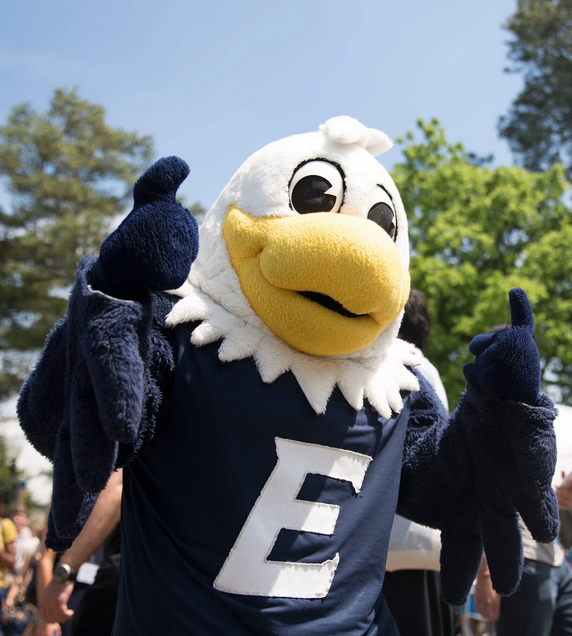
And so it is with Swoop the Eagle, mascot of Emory athletics teams and symbol of the indefatigable, if not invincible, spirit of the University. For no one seems to really know when Swoop was hatched.
True, the web page for Swoop on the Athletics Department website lists his date of birth as July 4, 1986. Surely, though, that cannot be correct. The first public photo of Swoop appears in the issue of the Emory Wheel dated October 25, 1985. There, a bird who looks nothing like the twenty-first-century Swoop cheers on Eagle Fever Weekend “to highlight the University’s athletics.” A full-page ad declares, “Eagle Fever 1985 Swoops the campus” and includes a cartoon of a flexing eagle wearing a shirt with “Swoop” on the chest.
Even earlier, in the March 8, 1985, Emory Wheel, an ad proclaims the opening of The Swoop Shop near the equipment room in the Woodruff Physical Education Center. One and all are invited to “Come by and meet Swoop!” Presumably Swoop was more than a mere fledgling by then.
If anyone was present when the egg was laid, Gerald Lowrey 81PhD seems to have the best claim as midwife. After coaching track and cross country at Emory for several years, Lowrey was named director of athletics in 1983, the year the Woodruff PE Center opened.
That year also saw the separation of sports programs at Emory into the Health and Physical Education Department, under the aegis of Emory College, and the Athletics and Recreation Department, under Campus Life. While Lowrey took the reins of athletics, Emory legend Clyde Partin Sr.—“Doc Partin”—became chair of health and phys. ed. Talk was in the air that a new intercollegiate conference might be in the works as well, heralding expansion of team sports at Emory.
“We added a number of sports to the athletics program when we finished the gym,” Lowrey recalls. “There was new energy, more excitement.” Although Emory famously has never competed in intercollegiate football, other sports had developed into varsity programs through the middle of the twentieth century—notably swimming, tennis, soccer, and track.
The appetite for intercollegiate sports seemed to pique a special hunger for hoops. As conversations about the new conference went forward, men’s basketball became a club sport and took to the road as well as hosting visiting teams. Lowrey saw something missing, though.
“I thought we needed a mascot, especially at home basketball games. I would go to our away games and see that other schools had mascots. We didn’t really have anything—no cheerleaders, no pep band, not even a logo, let alone a mascot.”
But what would that mascot be? Lowrey wrestled briefly with the thought of bringing in Dooley, the skeleton who represents “the spirit of Emory” and appears for a week each spring as the lord of campus misrule. “But did we want to have a skeleton on the basketball court?” Lowrey wondered. “What would he do—throw bones to the fans? Perform a soft-shoe shuffle to ‘Puttin’ on the Ritz,’ like Fred Astaire with his top hat and cane? We were the Eagles, so why couldn’t we have multiple mascots?”
Emory sports teams had been known as the Eagles since 1962, when then-sports editor of the Emory Wheel, David Kross, decided that former names for Emory teams would no longer do. No more Teasippers or Gentlemen or—for heaven’s sake!—Hillbillies. Kross suggested the Eagles, and why not. According to one website, the eagle is the most popular collegiate mascot in the United States. And, hey—“eagle” begins with “e,” just like Emory!
Inspired by the thought of an eagle mascot, Lowrey set off to an Atlanta costume shop to find an avian outfit. “It looked like a brown blanket with a chicken head on top,” he says. Indeed, that appears to be the “Swoop” in the 1985 photo in the Wheel.
Unhappily, the undignified and unimposing appearance of the so-called eagle at several games proved too embarrassing, so Lowrey searched for an alternative. He contacted people at Six Flags over Georgia. Perhaps, he thought, a Disney-like amusement park might have some costumed characters roaming around, and Six Flags might be able to put him in touch with a costume company. In fact, they could. For twenty-five hundred dollars, Lowrey stretched the athletic department budget and bought the first blue-gold-and-white outfit for the Emory mascot.
But what to call this bird? Like the former sports editor, Lowrey landed on an E name—Euripides! Really. He reasoned that an eminent academic institution could well have a mascot inspired by a Greek playwright whose name began with the Emory E. For short, the bird could be called Rip! “Rip ’em Eagles!”
To his credit, Lowrey invited other suggestions and proclaimed a referendum to settle on the name. The issue o October 19, 1984, issue of the Emory Wheel carried a text box with a bold headline: “You can name the Emory Eagle!” The blurb went on to say, “Tonight at the basketball club’s season opener against Kennesaw you will have the chance to name the Emory Eagle. Each person will receive one ballot and will choose from one of four names: Egor, Emmy, Swoop, or Rip. Come out and support the team and support our mascot too!”
Where the other three names came from—including the unusually spelled “Egor”—is another mystery, but when the results were tallied, Swoop won “in a landslide,” according to Lowrey.
By the summer of 1986, plans to launch the new NCAA Division III conference—called the University Athletic Association—had matured, and the new school year would usher in intercollegiate sports at Emory on a more intense level. Arriving at the same time was Joyce Jaleel, who began her career in the athletics department as an office manager but now serves as senior director of athletics, overseeing sports medicine, strength and conditioning, and student athletic development.
Noting the birthdate for Swoop on the departmental website, Jaleel suggests that a number of factors went into the selection of July 4, 1986. It was the year of Emory’s sesquicentennial and the year that the University Athletic Association was launched, while July 4 is, of course, the birthday of the United States. And what is more symbolic of the national birthday than a bald eagle, the national bird.
In her years with the department, Jaleel has seen Swoop up close and personal many times—so close and personal, in fact, that on at least one occasion she has had to BE Swoop. No students were available to don the mascot’s costume on one particular day, so the five-foot-three Jaleel stepped into the suit and put on the head (technically called the helmet). Swamped by the large outfit, Jaleel found it “not that heavy—just hot and uncomfortable.” Apparently after one takes it off, one heads for the showers.
Because the suit is so hot, Swoop is limited to a two-hour shift at any event, with a break midway to ensure that he’s doing okay. He takes some water, checks in with his handler (there is always someone with him), and decides whether he wants to go on with the show. Usually he does.
“You can imagine the costume gets dirty and sweaty,” Jaleel says. So after each outing, the suit gets tossed in the laundry, and the head and shoes are sprayed with disinfectant.
Swoop also has his own kind of molting—a total suit replacement, every five years or so. The original blue costume (after the short-lived brown-blanket-and-chicken-head outfit) came in a kind of robin-egg pastel blue. In 2005, as Emory undertook an updating of its logo, branding, and identity design, Swoop came repackaged in a darker blue. The most recent tweaking of his look, just before the pandemic, gave him more fierce-looking eyebrows and a more aggressive – er – competitive mien.
Is Swoop male? “We refer to him as a he, but that’s a great question,” Jaleel says. After all, not every person who wears the costume is necessarily a male.
Truth be told, both male and female students become Swoop from time to time. The person responsible for recruiting them is Corbin Bryant, director of marketing and events for Emory athletics. A former NFL defensive end (he played for the Steelers, Bills, and Giants), Bryant came to Emory from a similar position at the University of Georgia, where he was part of a nine-person staff, and where the bulldog mascot, named UGA, has an entourage.
If Swoop flies with fewer companions, he is nonetheless a celebrity. “Swoop is one of the more popular ‘people’ on campus,” Bryant says. Students particularly like to take selfies with him. “I don’t know why,” he deadpans.
Bryant says that it’s easy to recruit students to perform as the mascot, and he currently has six on call. There are only two qualifications: the right height (minimum of five-eight, and maximum of six-two), and the ability to get into the suit. “That can be a challenge,” Bryant says.
The height requirement means that the six-foot-five Bryant can’t do it. “Thank God,” he adds.
But he notes that the students who wear the costume love doing it. “They enjoy putting the suit on. They take pride in it.” In fact, one of the current volunteers served as his high school mascot for three years. “He’s kind of a professional mascot,” Bryant says. At one home game, this student’s version of Swoop ran around the gym waving an Emory flag on a pole, not something everyone would be capable of.
Asked if Swoop can do cartwheels or tricks, Bryant says that “if you wore the suit, you wouldn’t want to try a cartwheel.” The suit is relatively lightweight, and the head weighs about as much as a football helmet, but with a nine-foot wingspan the costume is not exactly made for gymnastics and acrobatic dancing.
Once suited up, however, Swoop has pretty much free rein, with only one hard and fast rule—no talking. Despite frequent questions from admirers, Swoop cannot converse. No eagle does!
Swoop does fly far and wide, including to places as distant as Oxford and Covington, Georgia. While the University joined in founding the University Athletic Association in 1986, the athletics program at Oxford College existed on a different plane. Not until the next decade did athletics at Oxford undergo a kind of revival.
Joe Moon, the former Oxford dean of campus life, now retired, recalls that some of the impetus for a larger athletic program at Oxford came from rugby players, who caught the attention of then-dean William Murdy. The dean thought that campus spirit would be enlivened by some team sports, and formal programs began in 1999. The next year, the athletics department on the Atlanta campus agreed that Oxford should have an eagle mascot.
As Roderick Stubbs recalls, the Emory athletics director at the time, Chuck Gordon, wanted to differentiate the eagle in Atlanta from the eagle in Oxford. Athletes on the Atlanta campus participated in NCAA Division III, while Oxford athletes participated in the NJCAA—the National Junior College Athletic Association. So the Oxford eaglet was christened with a different name—Screech!
Stubbs, who came to Emory as the assistant AD and men’s basketball coach at Oxford, has been the Oxford AD since 2013. He recalls that “students were getting confused” by the two different eagles. Fight songs and cheers referred to Swoop, so who was this “Screech” that kept appearing at Oxford events? Appealing to the now-retired Emory athletics director Mike Vienna, Stubbs persuaded him to agree to a name change, and since 2018 Swoop has made Oxford his aerie away from home.
Several differences remain, however. While the Emory Swoop has a bespoke outfit, the Oxford Swoop wears off-the-rack. On the other hand, the Oxford Swoop may be more of a terpsichorean performer, because the dance coach at Oxford coordinates movements and teaches them to the students who take on the part.
Now closing in on his fortieth birthday (whenever that is), Swoop can take his place with the best of traditions. Like Santa Claus and the Easter Bunny, he has undergone superficial changes in appearance over the years. But his essence remains unblemished by time, undiminished by the occasional team loss, and unflagging in his spirited cheering of Team Emory. “Hail the Gold and Blue.
 Emory Historian's Blog