Muhammad Ali, Emory, and Me

I never met the man whom Sports Illustrated designated the greatest sportsman of the twentieth century. But somewhere at home I have his autograph. It’s inside my copy of King of the World, signed not by the author (David Remnick) but by the subject himself—the Greatest of All Time, or G.O.A.T. The book is subtitled Muhammad Ali and the Rise of an American Hero.

Ali’s death earlier this month reminded me of the occasion for my receiving that book. It was made possible by an Emory hero, who passed away just three months before Ali himself. That man was Herbert R. Karp, a graduate of Emory College (1943) and Emory School of Medicine (1951), who had a long and distinguished career as neurologist, chair of the Department of Neurology, and first medical director of the nation’s first geriatric hospital, the Wesley Woods Center. He retired at 90 and died at a youthful 94.

One of Emory’s great faculty citizens, Herb received the Thomas Jefferson Award in 1983 for his service to the university. By the 1990s his leadership needed still more recognition, so the Herbert R. Karp Leadership Award was created to honor persons who advance understanding of neurological diseases.

Beginning in 1994 Ali was coming to Emory for treatment of his Parkinson’s disease by Mahlon Delong, the William Timmie Patterson Professor of Neurology and recipient of the 2014 Lasker Award for his transformative work in treating Parkinson’s disease.

In the spring of 1999, three years after Ali lit the cauldron during the opening ceremony of the Atlanta Olympics, I received a request. Ali would be coming to Emory again, and the Woodruff Health Sciences Center wanted to present him with the Karp Award at a small ceremony. Would I write a citation for the occasion? No guarantee that I could meet the champ.

Of course I agreed, and here is the citation that was read as The Greatest received the award named for another great man.

The President, Faculty, and Trustees of Emory University take pleasure in honoring

MUHAMMAD ALI

Known in the world’s smallest hamlets and glens,

Feted in palaces, cheered to the sky,

Bearing the name of Muhammad (which means

“Worthy of all praise”) Ali (“The most high”).

Shaking the world, you held fast to your soul,

Pugilist wearing world peace as a belt;

Boxer, now helping the battered live whole.

Self-contradictions resolve themselves, melt.

Raising a torch of Olympian fire,

Thus, in an image, rekindling joys past;

Teaching us life’s hardest lesson—that dire

Change comes to all, and all must be, at last,

Grateful for mercies and magic—for grace

Poetry gives when the spirit lives free:

These things we ponder while noting your place—

Spelled with initials, the G-O-A-T.

You show us how to live life as an art:

Float like a butterfly—lead with your heart.


I never did get to meet the Champ that day. But I look forward to rereading the book.

Gary Hauk
Into the Woods

Just down the hill from the Miller-Ward Alumni House, on Houston Mill Road, is the entrance to Hahn Woods, formally known as the T. Marshall Hahn Commemorative Forest.

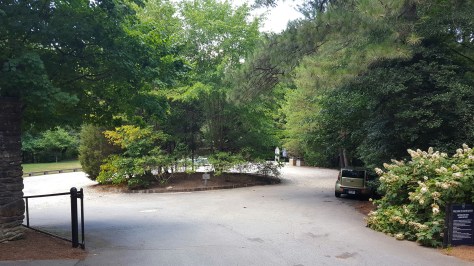
Hahn Woods parking lot
The parking lot at Hahn Woods.

This Emory landmark came to mind last week when I learned of the passing of the man for whom the woods are named—T. Marshall Hahn Jr., Emory trustee emeritus and former CEO of Georgia-Pacific. Among his achievements were a PhD in physics from MIT at the age of 23 and appointment at the age of 35 to the presidency of Virginia Tech, which he built into a research university during his tenure from 1962 to 1974. His obituary from the Roanoke (Va.) Times is here. Marshall had served as chair of the Emory trustees’ Investment Committee and a member of the Executive Committee until his elevation to emeritus status at age 70 in 1997. He blended academic aspiration and business acumen in an extraordinary way.

Hahn Woods is well worth a visit. A stroll along its paths not only leads into a literal grove of academe but also introduces something of the area’s history.

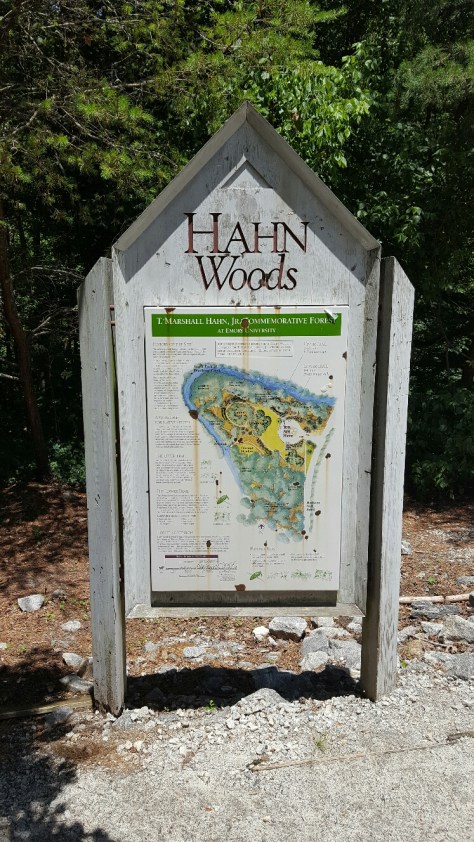
Hahn Woods marker

This 4.7-acre preserve was part of a 60-acre parcel that the university acquired from the owners of the Houston Mill House in 1960. In the succeeding decades Emory covered over a pasture and a swimming pool with construction debris, creating a landfill.

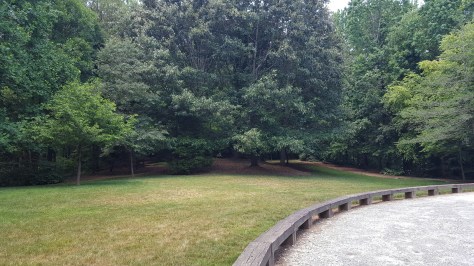
Hahn Woods meadow
The meadow at Hahn Woods formerly was used by Emory as a dump for construction debris. Before Emory acquired the land from the Harry Carr family, in 1960, a swimming pool had been on the site.

In 1993, through a partnership with Georgia-Pacific, which sought to honor its retiring CEO, the university began reclaiming the site as a teaching area for environmental preservation—an effort dear to Marshall’s interests.

Entering the woods from the parking lot, you have a choice between an upper trail, leading past the meadow, or a lower trail that skirts the creek.

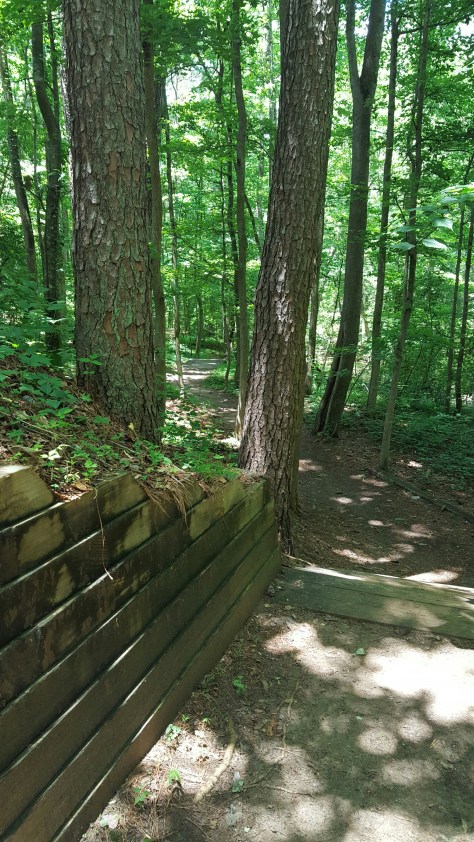
Hahn Woods path
The beginning of the lower trail in Hahn Woods

Washington Jackson Houston (pronounced HOUSE-ton) chose this site along the South Fork of Peachtree Creek for his mill, for which the nearby road is named. Houston acquired the property in 1842 from his father, Dr. Chapmon Powell, who had settled in the Decatur area in the 1820s and is buried with his wife and other family members in the cemetery on Emory’s Clairmont Campus.

Houston built a dam in the ravine to the east of the road.

Houston Mill dam
Houston Mill dam today

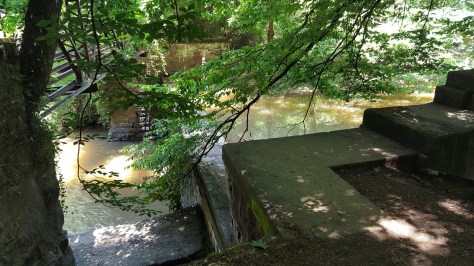
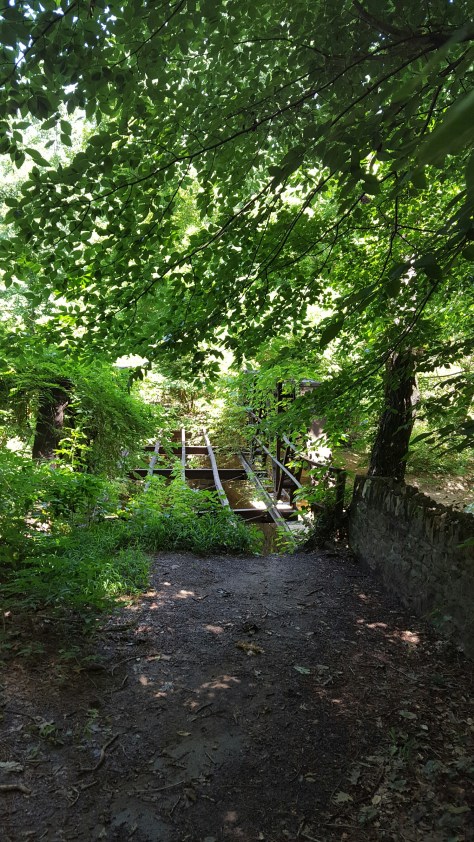
Just downstream stand the remains of a single-lane bridge that once carried traffic on Houston Mill Road across the creek. This iron bridge was replaced by a concrete bridge in 1952—the same concrete bridge still used by hundreds of commuters daily.

Houston Mill old bridge
The remains of Washington Jackson Houston’s iron bridge.

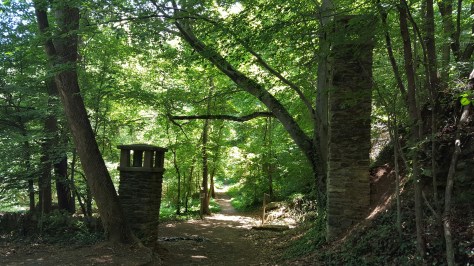
Pillars mark the path leading past the dam.

Hosuton Mill stone pillars

Around 1900 Houston converted his mill operations from grinding grist to generating electricity.

In the 1920s Harry Carr acquired the property and resumed grist milling. He built his Houston Mill House in 1925—the same year that Walter Candler developed his Lullwater estate half a mile upstream. Following Carr’s death in 1958—again, coincidentally, the year Emory acquired Lullwater—Emory in 1960 negotiated the purchase of the property from his widow with the provision that she be permitted to live in the house until her death. She died in 1976.

Hahn Woods lower trail
The lower trail, looking upstream toward the bend to the parking lot at Hahn Woods.

Hahn Woods now hides a lot of history but still retains traces of the past on which Emory’s campus has been built.

Gary Hauk