Halloween, ghosts, and graveyards

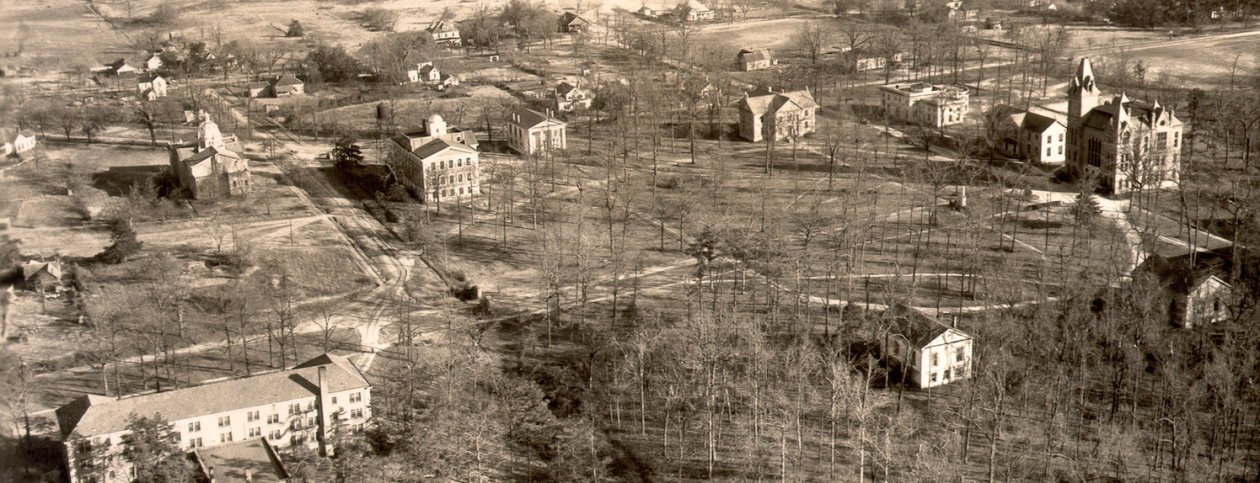
Every campus should have its ghosts, or at least its ghost stories, and Emory does. Some students claim to have “felt” the spirit of President Atticus Haygood in Old Church at Oxford. One former staff member of the alumni association tells a hair-raising story of encountering a man in an old-fashioned suit and a bowler hat while working on the second floor of the Houston Mill House—a man there one moment and gone the next. And heaven (or hell!) only knows what goes on at the Briarcliff mansion, but check it out here.

The best Emory ghost story surely comes from Mike Wilhoit, who 45 years ago was working late at night in the Tufts House (formerly Uppergate House), when he encountered a woman who couldn’t have been there but was–and then wasn’t.

For those in search of more mundane encounters with “spirits” from the past, two cemeteries at Emory beckon. One is on the Oxford campus and harbors the graves of Confederate soldiers who died while being cared for in Oxford after the Battle of Atlanta.
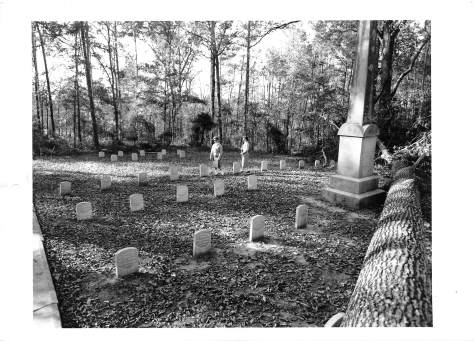
confederate-cemetary-1959-ev-15_page_1-copy
The Confederate cemetery near Williams Gymnasium at Oxford College, as it appeared in 1959—much as it appears today.

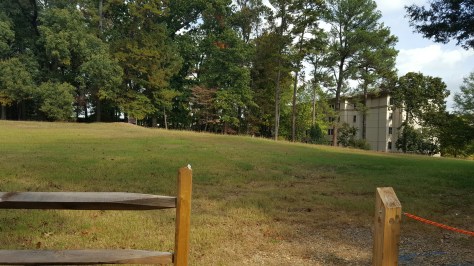
A second cemetery lies tucked away, half-hidden, on the Clairmont Campus in Atlanta. Shuttle-bus riders and pedestrians, as well as parents picking up children at the Clifton Childcare Center, often pass by without realizing that some fifty bodies lie buried nearby.
hardman-cemetery-view-toward-building-d
Countless shuttle riders and pedestrians pass the Hardman Cemetery without seeing its sign at the top of the knoll.
hardman-cemetery-sign
The cemetery on Emory’s Clairmont Campus harbors the remains of some of DeKalb County’s early settlers. The earliest is from 1825, and the most recent from 1909.

Richard Houston Sams, Emory College Class of 1957, has written the fullest history of this hallowed ground, and he has good reason for his interest in it—some of his ancestors are buried there.

The earliest grave is that of Rody Harriet Hardman, just a year and a half old when she died in 1825. She was the daughter of John Hardman, who was laid to rest near her more than half a century later.

hardman-rody-grave
A small, blank stone in the corner of the Hardman plot marks little Rody’s grave.
john-johnny-hardman-1793-1879
John “Johnny” Hardman, 1793–1879

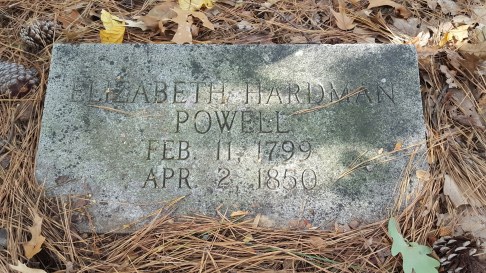
Not far from the Hardman plot lie Dr. Chapmon Powell and his wife, Elizabeth Hardman Powell, parents of Amanda Powell. In 1854 Amanda married Washington Jackson Houston–the builder of Houston Mill and great-grandfather of Richard Sams.
hardman-cemetery-elizabeth-powell

Somewhat farther away, near the edge of the cemetery, lie the foundation stones on which, sometime around 1830, Naman Hardman built a church known as the Primitive Baptist Church in Christ at Hardman’s. This building, according to Sams, was still standing when a wing of General Sherman’s army marched down the Shallowford Trail–now Clairmont Road–toward Decatur in July 1864. Sams says the structure was left in ashes by the time the army left.

Much more history haunts these two acres, which are owned not by Emory but by the DeKalb Historical Society. The spirits inhabiting the place include the land’s original inhabitants, the Creek Indians, who lived along the South Fork of Peachtree Creek, near where the VA Hospital stands on Clairmont Road. Meanwhile, this quiet corner tucked between a parking deck and apartment building D offers tranquility for visitors on a balmy autumn afternoon.

hardman-cemetery-view-through-trees
The tranquility of the graveyard belies the bustle of the parking deck, apartment building, and shuttle road that surround it.


Gary Hauk

The cornerstone at the dumpster

Clyde Partin Jr. tells the story of how a piece of Atlanta and Emory history was discovered beside a dumpster on the Emory campus fifteen years ago. Clyde is a graduate of Emory College and Emory School of Medicine and the son of the legendary long-time Emory athletics director and coach, the late “Doc” Partin. As Clyde tells it, his parents were walking to Emory’s baseball field at Chappell Park one fall day in 2001, when they came upon “a monolithic piece of granite, like a huge tombstone, lying next to the dumpster.” (He and John Stone relate the story in Atlanta Medicine, Volume 77, Issue 2 (2003), pp. 12-16.)

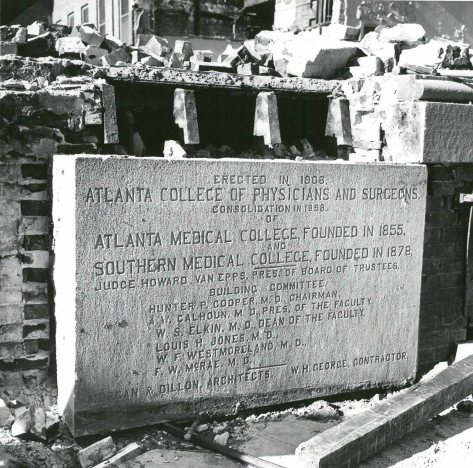
The elder Partins contacted Clyde Jr., whose investigation determined quickly that this was the cornerstone of the old building of the Atlanta College of Physicians and Surgeons, a precursor to the Emory School of Medicine. The ACPS itself had been formed in 1898 from the merger of two other medical schools, both of which traced their lineage to Atlanta’s first medical school, the Atlanta Medical College. (Emory’s fourth president, Alexander Means, taught briefly at the Atlanta Medical College in the 1850s.) After several splits and mergers, in 1906 the ACPS moved into new quarters at the corner of Armstrong and Butler streets—now Armstrong Street and Jesse Hill Jr. Drive—across from Grady Memorial Hospital.

atlanta-college-of-physicians-and-surgeons
This photo of the Atlanta College of Physicians and Surgeons appeared in the 1911 edition of the school’s yearbook, Aesculapian, now in Emory’s Stuart A. Rose Manuscript, Archives, and Rare Book Library. The cornerstone is at ground level, facing the fire hydrant.

By the 1960s the building needed to be replaced, so down came the five-decade-old structure—its piecemeal deconstruction recorded in photographs.

old-med-sch-wrecking
The Atlanta College of Physicians and Surgeons is taken apart, piece by piece.

Soon the cornerstone itself was detached from the wall surrounding it, and a cavity at the top of the stone was uncovered. In that cavity was a metal box

old-med-sch-cornerstone
The cornerstone stripped of its building.

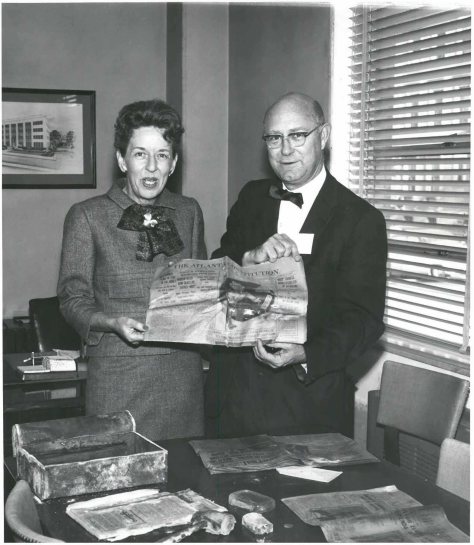
With Emory dignitaries on hand, including the board chair, the university president, and the dean of the medical school, the “time capsule” was retrieved and opened.

cornerstone-opening
Looking on, as a worker (back to camera) opens the box from the cornerstone, are (clockwise) board chair Henry Bowden, Emory president Walter Martin, Dr. Phinizy Calhoun Jr., and medical dean Arthur Richardson. Dr. Calhoun’s grandfather, Dr. A.W. Calhoun, was present at the dedication of the building in 1906.

The contents of the box appear to have been just whatever was at hand on the day the cornerstone was laid—no profound messages from one generation to a later one, no poetry or spiritual wisdom, no valuable treasures or cultural secrets to be passed along to an inquisitive bunch of archaeologists. Just a daily paper with news of the moment, a physician’s empty stationery envelope, and sundry odds and ends.

cornerstone-contents
Medical library director Mildred Jordan and medical dean Arthur Richardson display the contents of the cornerstone’s box: daily newspapers from 1906, a gavel, a paperweight, a disintegrated box of matches, a catalogue for the Atlanta College of Physicians and Surgeons, an 1893 Indian head penny, and a spool of wire.

What happened to the cornerstone after its removal from the site in 1961 is anyone’s guess, and as Clyde notes, how it came to rest by the side of that dumpster is still more of a mystery. It now graces the plaza of the Woodruff Health Sciences Center Administration Building.

stone-and-partin-with-cornerstone
In this photo from 2003,  Dr. John Stone (left, now deceased) and Dr. Clyde Partin Jr. perch above the old cornerstone in its current location, at WHSCAB.

Emory medical faculty members still play their teaching and medical arts on the site of the old Atlanta College of Physicians and Surgeons, in the building that replaced the 1906 structure.

emory-faculty-building-at-grady-hospital-former-site-of-acps
The Emory Faculty Building at Grady Hospital, on the site of the former Atlanta College of Physicians and Surgeons. Butler Street is now Jesse Hill Jr. Drive.

Gary Hauk

The water tower and the golfer

It stood above the campus like a sentry, as if to guard against drought and keep watch for welcome rain clouds on the horizon. In my recollection it was always blue, though not Emory blue–more like the blue of a robin’s egg.

It should have been painted white, with trompe l’oeil stippling to mimic the look of a golf ball. Because after I heard someone refer to it as “the Bobby Jones Memorial,” I could never again see it as anything but a golf ball on a tee. (Bobby Jones was the Emory alumnus who graduated from the law school in 1929 and went on, the following year, to become the only person ever to win the grand slam of golf. Some of his papers — and a bronzed golf shoe! — are held in the Stuart A Rose Manuscript, Archives, and Rare Book Library.)

water-tower-in-r-d-cole-catalogue-copy
The old water tower on Emory’s campus resembled a golf ball on a tee. The tower appears here in the catalogue of the manufacturer.

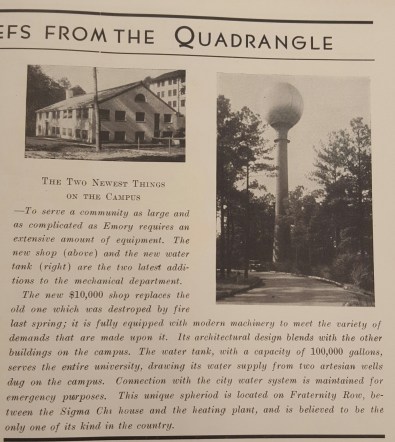
The tower was installed in 1933 and made it into the pages of the November-December 1933 Emory Alumnus.

water-tower-in-emory-alumnus

By 2007 the water tower, in terms that Bobby Jones would have been familiar with, had become a waterless hazard. It had not held water since the 1980s, and improvements to maintain its structural integrity were estimated to cost several hundred thousands of dollars. While realigning Eagle Row to make way for new residence halls, the university dismantled the tower and recycled its steel.

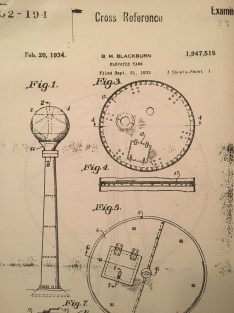
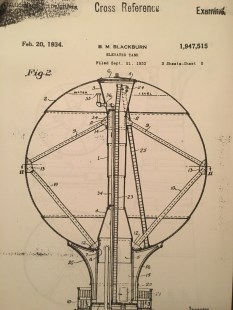
I learned recently that Mathew Pinson, senior director of development in the Candler School of Theology, has a personal connection to that bygone tower. His great-grandfather, Bryan M. Blackburn, was employed by R.D. Cole Manufacturing Company in Newnan, Georgia, when he patented the design of the hundred-thousand-gallon tank. Mathew shared images of the design that was approved by the US Patent Office on February 20, 1934 (after the tower had been installed at Emory). The patent and the catalogue from the R.D. Cole Manufacturing Company are in the Pinson family archives.

water-tower-patent-diagram

water-tower-patent-diagram-2

Great-grandfather Blackburn was a member of the twenty-fifth graduating class of Georgia Tech and began developing this design while he was a student.

Great thanks to Mathew for sharing these design images and the information about his ancestor.

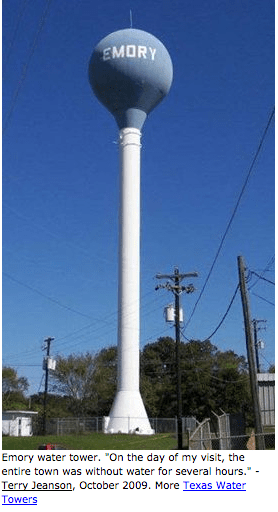
Curiously, Emory University was not the only Emory with a water tower that resembled a golf ball on tee. Check out the one from Emory, Texas, below. I believe ours was built first–and unfortunately had to be removed first.

emory-texas-water-tower

Gary Hauk