Emory’s other two-year college

Oxford College of Emory University has flourished over the past three decades and is now, more than ever, a sparkling jewel in the Emory crown. It is also unique in American higher education–a two-year college completely integrated into a major research university.

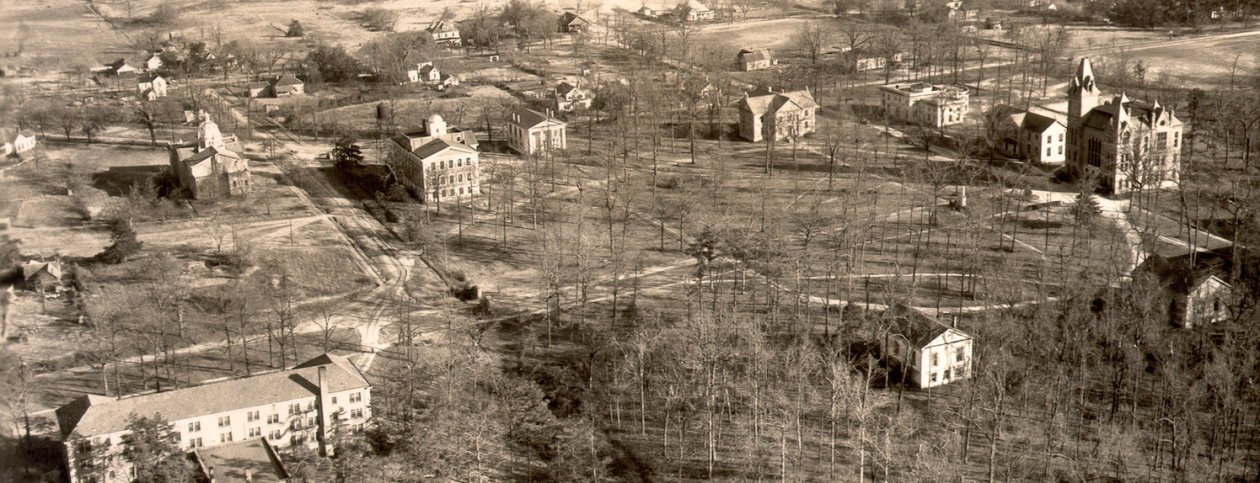
Many people are unaware, though, that Oxford College was not Emory’s first two-year division. That distinction belonged to a campus in Valdosta, Georgia, about ten miles from the Florida border and nearly 250 miles from Atlanta.

It’s not entirely clear why the citizens of Valdosta petitioned Emory in 1927 to create a two-year college in their town. The state had established a “normal college,” or teachers’ college, in 1906 but didn’t provide funds to open it until 1913. In 1922 the college was renamed Georgia State Woman’s College, so perhaps the dedication of the college to the education of women prompted the city’s leaders to look for gender balance from Emory, which at that time educated mostly men.

Whatever the reason, the request came at an opportune time. Emory College was revamping its curriculum to create a “lower division” and an “upper division,” essentially dividing the undergraduate student body into a two-year general-education college, after which students would specialize in their last two years. This concept translated easily to a campus almost in Florida. Students there could complete the same foundational courses as those on the Atlanta campus, then come to Atlanta for their last two years of baccalaureate work.

In 1928, with a gift of forty-three acres, a main building, and a $200,000 endowment from the city, Emory launched Emory-at-Valdosta. The building shown in the photo below served as the administration and classroom building.
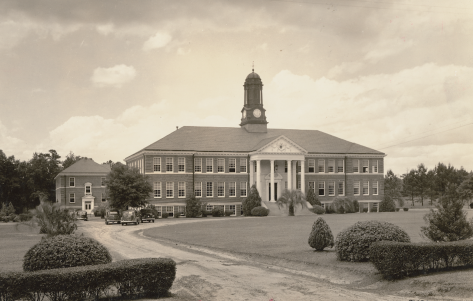
Screen Shot 2017-11-28 at 10.36.43 AM
Emory-at-Valdosta, photo courtesy of Emory University Photograph Collection, Stuart A. Rose Manuscript, Archives and Rare Book Library.

The photo below, from the estate of Gardner B. Allen and held in the Rose Library collections, shows students, faculty, and administrators gathered on the steps of the Assembly Hall (now the AMUC) during “Junior College Day,” May 1930. Kneeling in front are, left to right, President Harvey Cox holding the hand of a little girl; Comer Woodward, dean of Emory-at-Oxford; William B. Stubbs 19C, dean of Emory-at-Valdosta; Goodrich White, dean of Emory College; and Theodore Jack, dean of the Graduate School. The children are unidentified. Stubbs, a Rhodes Scholar, had practiced law in Savannah before becoming the founding dean of the new junior college in Valdosta.

Screen Shot 2017-11-13 at 10.48.49 AM

During World War II, Emory closed the Valdosta campus and transferred faculty and students to Atlanta. For a short period after the war, enrollment climbed to nearly 250, but when the state decided to enlarge the women’s college and make it coeducational in 1950, the death knell sounded for the Emory junior college. As Emory’s higher tuition made competition with the state university challenging, enrollment at Emory-at-Valdosta slipped to sixty-five students in the spring of 1953. That May, the trustees of Emory, facing continuing deficits at the junior college, voted to offer the campus and its endowment to the University System of Georgia. The regents quickly accepted and incorporated the land and buildings into Valdosta State.

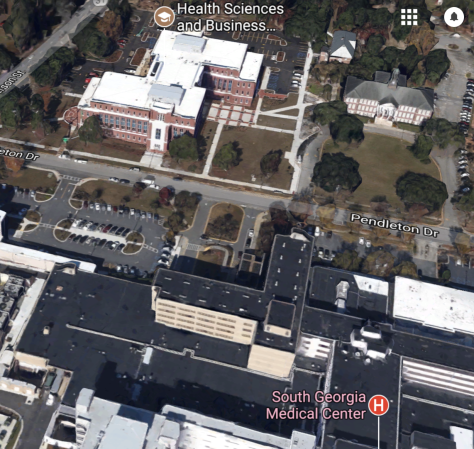
The original Emory building still stands on Pendleton Drive in Valdosta, now surrounded by other, more imposing structures that are part of the state university and the South Georgia medical Center.
Screen Shot 2017-11-13 at 12.32.43 PM
Satellite view from Google Maps.

Nowadays Pound Hall, as it’s called, houses the Harley Langdale Jr. College of Business Administration.

Screen Shot 2017-11-13 at 12.18.32 PM

Gary Hauk


Doggerel for the Class of ’77

One delight of my job is the invitations I receive to speak to various gatherings about days of yore at Emory. Such a gathering occurred during Homecoming last month as the Emory College Class of 1977 convened in Ackerman Hall of the Carlos Museum to renew friendships and swap reminiscences.

Emory Morsberger, who had served as Student Government Association president during the class’s senior year, recalled the astonishing fact that he won the Domino’s Pizza–sponsored pizza-eating and beer-drinking contest. What was astonishing about the event was not who won it—the identity of the victor is really immaterial—but that the university sanctioned the event at all. The drinking age in those years was 18. But still . . . Bishop Candler surely was turning in his grave.

Charged with the task of commemorating the class’s era in seven minutes or less, I went to work in Rose Library digging through the Campus yearbook, the Emory Wheel, and other sources, then penned a bit of doggerel to read aloud. For those readers who have memories of the era, some of the lines may ring with a note of familiarity.

Epic of the Class of Seventy-Seven

It was back in the autumn of seventy-three

When the Watergate scandal was raging,

And the gas lines were long because OPEC was strong,

And your parents were all middle-aging.


Pharrell Williams and FedEx were born in that year,

Hip hop launched a new genre of music.

On the other hand, Bruce Lee, Picasso, Jim Croce

All fell to the Grim Reaper’s choosing.


By the time that year ended King beat Bobby Riggs,

Nixon told the press “I’m not a crook.”

And the people before me—alumni/alumnae—

Had taken to life with a book.


It was then, as I’m sure you remember quite well,

That you came in your tie-dyes and blue jeans

To this old Druid Hills with its woodlands and rills,

Trading family and home scenes for new scenes.


And the fall of your first year at Emory was wild:

A Dooley’s Den coffee house opened;

Yom Kippur brought a war; gas prices still soared,

But at Horton’s, The Grille kept you copin’.


The dean who made Wonderful Wednesday resigned,

While the president looked toward retirement.

He enjoyed his pipe smoke while the students would toke,

Though today’s smoke-free campus would fire him.


In the fall of your second year traipsing the Quad

You could hear a quite famous exhorter,

As the great Margaret Mead told the students, “Take heed—

Your tuition’s nine-fifty a quarter!”


There was fear that old Emory was just for the rich,

While financial aid needed some boosting.

Meanwhile AMUC, alas, didn’t have enough class

As a place to support student roosting.


Through the culture at large there pervaded a sense

Of bleak doom that the era was rousing.

Yet if all went to pot, the doom simply would not

Put a damper on campus carousing.


By the time you were juniors a theme had emerged

In the pages of Campus, the yearbook:

Every party and dance seemed to offer a chance

For each student to have their own beer truck.


As September of seventy-six rolled around

You were wrestling with things existential:

Should you plan on more school, find a job, or play cool?

Meanwhile questions arose presidential.


For the nation was voting that fall to decide

Between Ford and our own peanut farmer.

While much closer to home, Sandy Atwood made known

He would take off his president’s armor.


As the board of trustees got a search underway

For the seventeenth leader of Emory,

Lots of other good things came on stage from the wings—

Let me name some and freshen your memory.


In November Theology remade its home

As a library, painting it pink.

Although students were pissed for the chapel they missed,

They soon left off from causing a stink.


In curricular matters, ten years of hard work

By a Methodist chaplain named Boozer,

Endowed a chair newish for studies quite Jewish.

David Blumenthal, hats off to you, sir.


At the business school two million dollars was tabbed

For enhancing the school’s future picture.

Soon a three-story stack was tacked onto the back,

And the Rich Building thus became—richer!


On the student front, life often felt like a grind,

Or so said a Wheel editorial.

The inadequate gym, dormitories quite dim,

And the ancient Alumni Memorial


Raised the question if twenty-five years farther on

There would be any student activities.

Surely something must change to address the full range

Of students’ creative proclivities.


As the search for a president grew more intense,

Unfortunately so did the winter.

That year it was colder than Aspen or Boulder—

Even Yankees at Emory felt bitter.


Well, the spring soon arrived, and the trustees announced,

After being with questions just peppered,

That theology deans were the stuff of their dreams—

They chose Laney to be Emory’s shepherd.


As you marched on the Quad in regalia in June

To receive your new-minted diplomas,

You may have felt shaken, as if now awakin’

From four-year-long undergrad comas.


For the world now before you was risky and cold

When compared to your warm alma mater.

But you went forth with grace and a smile on your face

Marked by Emory’s hard-won imprimatur.


Forty years have flown by in the blink of an eye.

Here you are for a wondrous regathering.

I have talked long enough about lots of old stuff

And should leave you to drinking and chattering.


But before I sign off, let me offer a toast

To the spirit with which you have leavened

Your Old Emory dear. Let us give a loud cheer

To the Class of Seventy-Seven!


Gary S. Hauk

Read to the reunion of the Emory College Class of 1977

At Carlos Reception Hall, October 21, 2017


Emory then and now                         1977                              2017

Fall enrollment (total)                        7,572                           15,252

Varsity athletic teams                               8                                   18

Full-time faculty                                   904                              3,000+

Degrees conferred                            2,010                                4,721

Total operating budget             $136.3 million                 $4.8 billion

Sponsored research                      $25.7M                             $628M

Endowment market value      approx. $165M            $6.5B (8/31/16)


An old building’s makeover

In an earlier chapter of my life, I worked for three years as the reference librarian in the Pitts Theology Library at Emory. The building fascinated me almost as much as the gargantuan collection of books, one of the finest assemblages of theological materials in the country.

Built in 1916, the Old Theology Building, as it is now called, is undergoing a renaissance. Part of the makeover includes its name. For sixty years it was simply the Theology Building, then for another forty the Pitts Theology Library. With the move of the Candler School of Theology into the Rita Ann Rollins Building in 2009 and the transfer of Pitts into new quarters in 2014, the heavily worn and now empty building became simply “Old Theology.”

Screen Shot 2017-09-27 at 2.17.47 PM
The Theology Building, circa 1920. Courtesy of Stuart A. Rose Library, Emory University.

Designed by the great Beaux Arts architect Henry Hornbostel, the Theology Building was half of a pair of twins that comprised the only academic buildings on the new campus in 1916. (The other was the Law Building, now Carlos Hall, which mirrors Theology.)

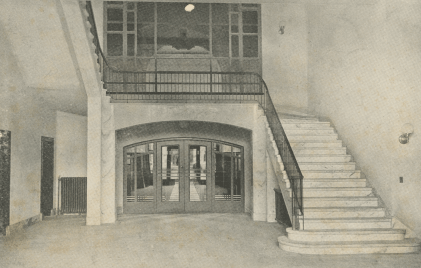
The building was both elegant and spare. Hornbostel’s sweeping staircase had little ornamentation, and the entrance foyer was minimalist.

Screen Shot 2017-09-27 at 2.08.35 PM
Early view of the Theology entrance foyer.

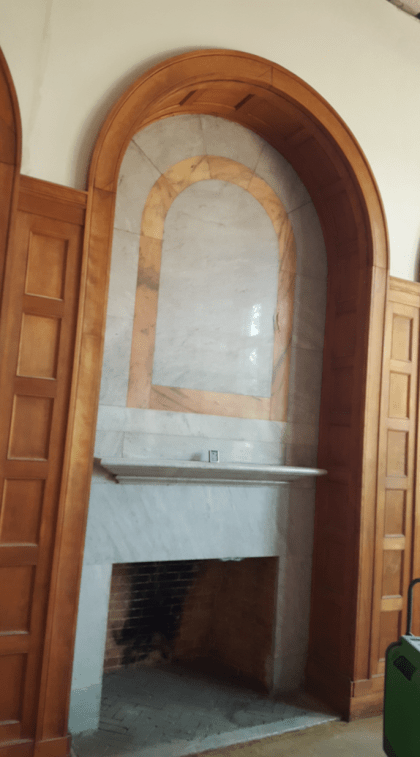
On the other hand, the wood-paneled office of Chancellor Warren Candler–later the theology dean’s office and then the theology librarian’s–had a marble fireplace that is being restored to working order with gas-burning logs.

Screen Shot 2017-09-27 at 1.54.17 PM
The chancellor’s fireplace.

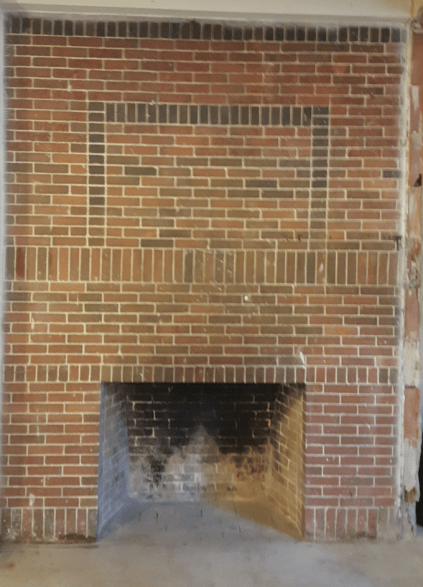
Amazingly, work crews stripping away old drywall this summer uncovered a long-forgotten fireplace below the chancellor’s office. This, too, will be restored to working order.

Screen Shot 2017-09-27 at 1.53.59 PM
Basement fireplace below the chancellor’s.

In the early years, the building served as a kind of attic for the University. Whatever they didn’t have room for elsewhere went into Theology. When Emory College moved from Oxford in 1919, the college dean had his office in Theology briefly, and the college library was squeezed into the basement until the Asa Griggs Candler Library was built in 1926.

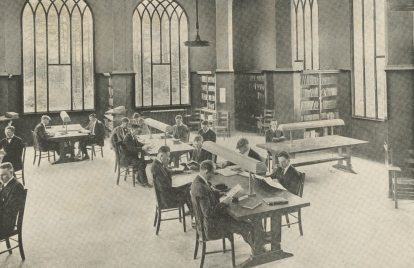
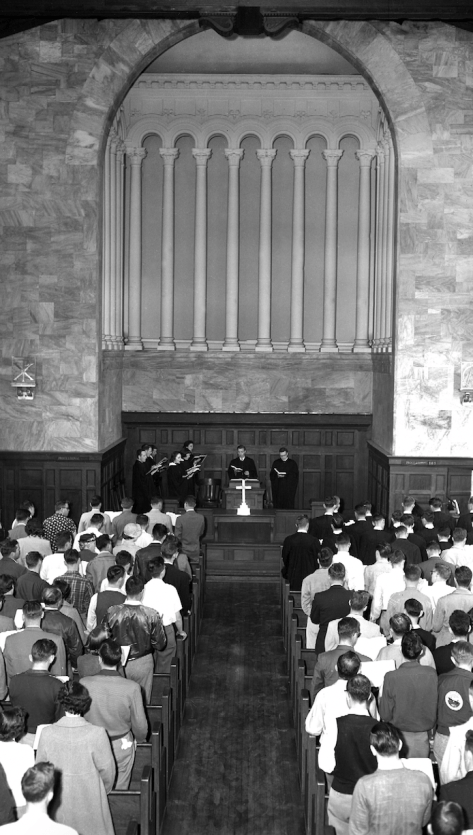
For most of its life, the building served the theology school as library, offices, classrooms, and chapel.

Screen Shot 2017-09-27 at 2.10.09 PM
Library reading room, circa 1930.


Then, in 1974, Emory acquired a 220,000-volume collection of rare books being sold by the Hartford Theological Seminary, and the entire building was made into the Pitts Theology Library. Paul Rudolph, dean of the Yale School of Architecture and son of the first graduate of Candler School of Theology, redesigned the interior of Old Theology to incorporate steel mezzanines in all the rooms, and fill the space with shelves. The chapel became a book-filled reference room.

Screen Shot 2017-09-27 at 1.56.01 PM
This second-floor room, once filled with shelves of books, will become offices after restoration of the Old Theology Building.
Screen Shot 2017-09-27 at 1.56.18 PM
The view from the second story, once blocked by an exterior steel fire escape, now looks onto Rudolph Courtyard and the new theology buildings. The fire escape will be replaced by interior fire stairs.
Screen Shot 2017-09-27 at 2.11.12 PM
Chapel service, circa 1950s. Courtesy of Stuart A. Rose Library.


Screen Shot 2017-09-27 at 1.54.58 PM
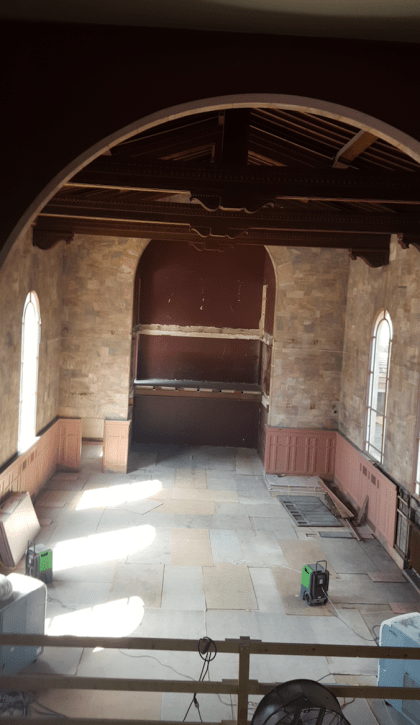
The former chapel will be revived as a place for University events.

In many ways, the restoration of the building will accomplish what Henry Hornbostel may have intended by his original design–a work that pays homage to the past through its neoclassical revival, while making room for engaging the present and preparing for the future. Fitted with high-tech digital capabilities, the restored building will also preserve the ornamentation and whimsical touches of its creator.

Screen Shot 2017-09-27 at 1.55.39 PM
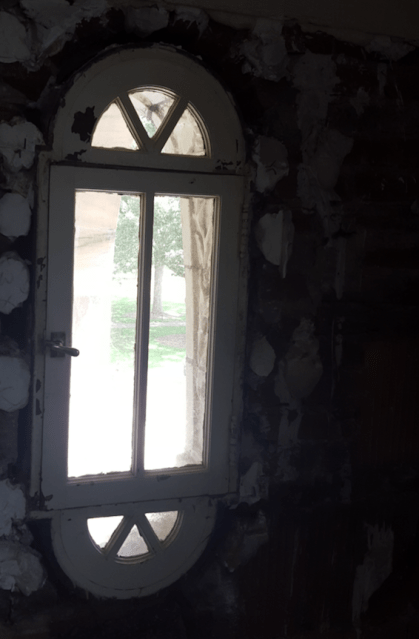
Interior of ornamental window in Old Theology.

Screen Shot 2017-09-27 at 1.55.18 PM
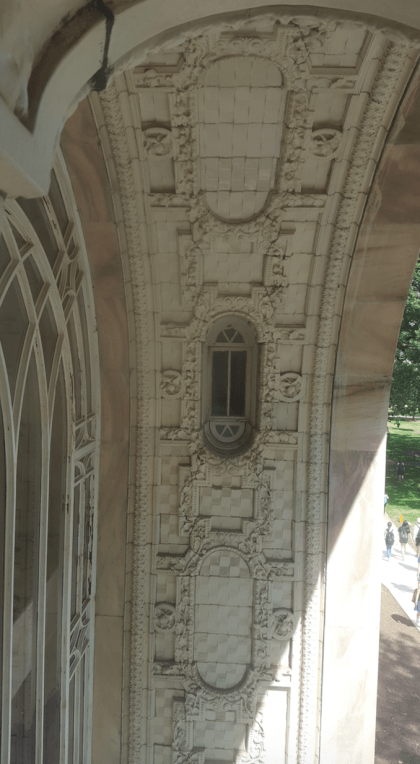
View from window to molding around entrance. Under the eaves, Henry Hornbostel alternated ornamental crosses with crowns of thorns to note that this was the Theology Building.

When it reopens sometime in 2019, the Old Theology Building once again will be a shining jewel on the Quadrangle.

Gary Hauk