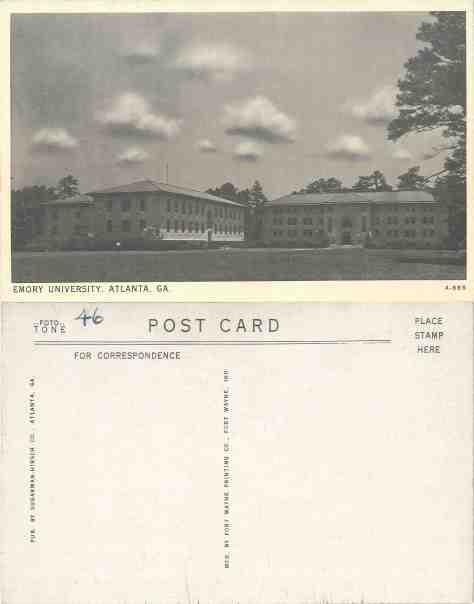
The corner of Winship and Dobbs

As the new Campus Life Center (CLC) rises to its full height and fills out the space formerly occupied by the Dobbs University Center (DUC), it’s good to recall what used to occupy that site.

The wonderful aerial photo below shows progress on the CLC as of two weeks ago. The Emory campus of 2018 is packed. Amazingly, the scene includes the Woodruff Library (upper-right corner), the Goizueta Business School (top), most of Emory Hospital and the Emory Clinic, some medical research facilities, the School of Medicine, some Campus Life facilities, and the newer freshman residence halls to the lower left. It’s either a beehive or an anthill.

Screen Shot 2018-03-19 at 10.40.18 AM

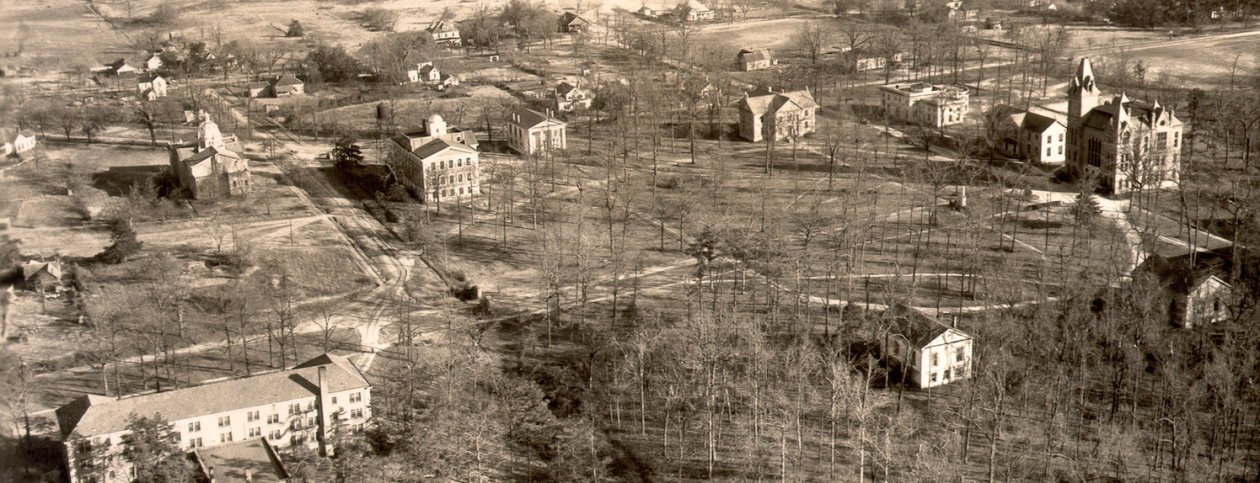
In contrast, the aerial below, from the 1930s, shows a similar perspective but a less built-up campus. The spot now occupied by concrete pillars and steel beams was, back then, the location of one of the first two dormitories on the Druid Hills campus, Winship Hall. That building bore the name of the trustee who paid for it, George Winship, who had had an extraordinarily successful career in manufacturing and cotton. He died at the age of eighty-one in April 1916, just months before the opening of the dormitory that would bear his name.

In the photo, Winship Hall  stands between the oval athletic field and the 1927 dining hall/auditorium, which was expanded to become the Alumni Memorial University Center in 1950.

Screen Shot 2018-03-19 at 10.44.42 AM
Photo from Stuart A. Rose Manuscript, Archives, and Rare Book Library

Below is a close-up of Winship from the 1920s. Note the lovey autos! The basement of this building provided space for the first gymnasium on the Druid Hills campus, but it wasn’t much of a gym by our standards. According to Clyde Partin Sr., in Athletics for All (Bookhouse, 2006), the gym contained “parallel bars and other equipment–poles, weights, Indian clubs, punching  bags, and mats, . . . along with room for wrestling and boxing.”

Screen Shot 2018-03-19 at 10.40.55 AM
Photo from Rose Library

When the University needed to expand the 1950s-era AMUC in the 1980s to accommodate a larger student body and more student organizations, Winship Hall came down, and in its place rose the west wing of the DUC. The legacy of Winship remained in the name of the Winship Ballroom, on the second floor of the DUC.

R. Howard Dobbs, who made the lead gift to help build the DUC, also served as an Emory trustee following an eminently successful career with the Life Insurance Company of Georgia.

By coincidence, the other of the first two dormitories in Druid Hills–across the street from Winship and, later, the DUC–also bore the name of Dobbs. This was  Samuel Candler Dobbs Hall, named for a nephew of Coca-Cola Founder Asa Candler. Samuel was no relation to Howard.
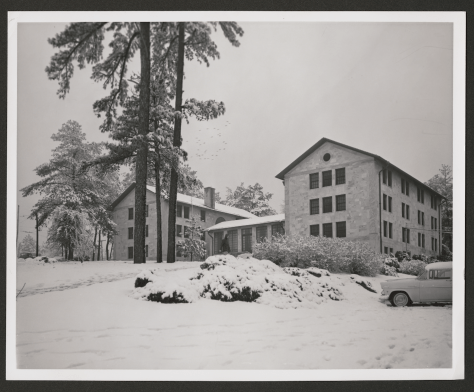
Screen Shot 2018-03-19 at 10.41.31 AM
Dobbs Hall, built in 1916 across Asbury Circle from Winship Hall and shown here in 1960, still serves as a dormitory for first-year Emory College students. Photo courtesy of Stuart A. Rose Manuscript, Archives, and Rare Book Library.

Samuel Dobbs worked for uncle Asa at the Coca-Cola Company and eventually rose to become president of the company from 1919 until 1920. In that capacity, he hosted the annual Coca-Cola Convention for a photo op in front of “his” dormitory in January 1920.

In the photo below, Dobbs is the man with the handsome head of curly white hair seated between two women. The woman to his right is most likely Lettie Pate Whitehead Evans, the first woman to serve on the Coca-Cola and Emory boards. (A residence hall at Emory bears her name.) The man to Dobbs’s left is bishop and University chancellor Warren Candler, and to Warren’s left sits his brother Asa Griggs Candler Sr.Screen Shot 2018-03-19 at 10.41.12 AM
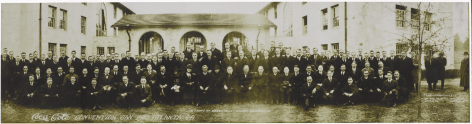
As they look toward the then-empty space that would be filled by the Campus Life Center a century later, it would be interesting to hear their thoughts about the way the place has changed.

Gary Hauk
Postcards from the edge–of the Quad

Al Dowdle III, a research administrator in the Yerkes National Primate Research Center at Emory, enjoys collecting old postcards, and some years ago he sent me scans of a few that he had come across here and there. Recently he sent me some more that show “dear old Emory” as it was fifty, eighty, or more than a hundred years ago. With his permission, I’m sharing them below with his comments and questions and my responses.

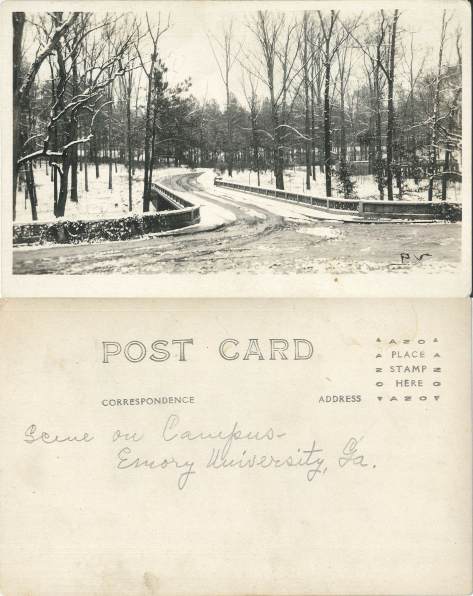
Al says: This is a real photo card, meaning the postcard was individually printed from a photographed image onto this photo paper and developed. From the stamp box, this paper was made between 1910 and 1930. Do you think this is the bridge behind the Carlos facing away from the quad?

a Emory Snow

Me: Yes, this is a view of the bridge now known as the Mizell Bridge, after Robert C. Mizell (1911C), long-time university administrator. In this photo, the photographer is standing near where visitors now enter the Carlos Museum from the ravine side of the building. The photo is rare because it shows not only the Mizell bridge but also, in the distance to the right, a bridge that no longer exists. The original drive into the campus crossed two bridges – one near where the Church School Building now stands, and the second behind the museum (Mizell). You can see a close-up of that first bridge on my blog post of July 27, 2017. In the July post, the photographer is looking toward where the Rich Building now stands.

Al: This is also a real photo card. Again dated from 1910 to 1930. The stamp was produced from 1908 to 1920. I think the postmark is 1923 or ’28? Where was this building? My mom, who was at Emory in the very early 1950s, does not remember it.

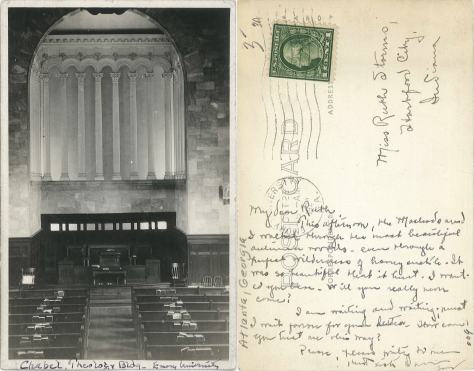
b Emory Chapel

Me: This is the chapel in the Old Theology Building (formerly the home of Pitts Theology Library). The building opened in 1916 as one of the first two academic buildings on the campus, across from its twin, the Law School (now Michael C. Carlos Hall). When the theology school acquired the Hartford Collection in 1975, the entire building was converted to library space, and this chapel was deconsecrated and filled with shelves. You can read more about this space in my blog post of November 8.

Al: I believe this is a white-border card dating between 1915 and 1930. Now that I look at it again, I think I have the same image in color. I will have to look.

c Emory Quad

Me: This photo certainly was taken after 1926, when Candler Library, facing the viewer, was opened.

Al: I love this card. It again is a real photo card. The paper was manufactured starting in 1950. The blue lettering on the left says “swimming pool.” I wonder what game the writer marched into wearing blue jeans?

d Emory Aerial

Me: Good question about the game; I don’t know what it might have been. It sounds like Karen was living on campus, in which case she may have been one of the first female students to reside on campus. That would date this postcard to after 1953. Her mother, Mrs. John E. Buhler, must have been the wife of the dean of the dental school at the time, Dr. John E. Buhler, who served from 1948 to 1961. (His deanship was marked by anti-Semitism in the school, a story told here.)

Al: I love the cars in this one. Post mark of 1971.

e Emory Wesley Woods

Me: They don’t make ‘em like that anymore! Wesley Woods was built by the Methodist Church in 1954 on a sixty-acre campus next to Emory and has been a partner of Emory’s ever since. In 1998 the geriatric hospital there–the first of its kind in the nation–became part of Emory Healthcare.

Al: “Lovely Glenn Memorial…” in 1955. Are those electric trolley wires in the top center of the photo?

f Emory Glenn Memorial

Me: Yes, those are streetcar wires. The streetcar stopped running past there in 1948 or so, and the car in the photo looks about that vintage, so the photo may be a decade old.

Al: I know this is not technically Emory, but I also have read the Atlanta College of Physicians and Surgeons eventually became part of Emory SOM. Postmark 1909. Does this look anything like the new SOM classrooms? I wish I could read all of the message on the back where the sender describes what they did in each room. “#3 is where I look at frogs.” The last line mentions a Halloween party with a “girl as sweet as a pickle.”

g Emory Atlanta College

Me: No, the latest SOM labs are a bit more up to date, thankfully. Looks to me like the card says “Ga. girls sweet as pickle.” I always thought they were sweet as peaches. It’s great to find these messages on the cards, though. Makes me wonder who will be reading my postcards a hundred years from now.

Gary Hauk