The vanished log cabin at Emory

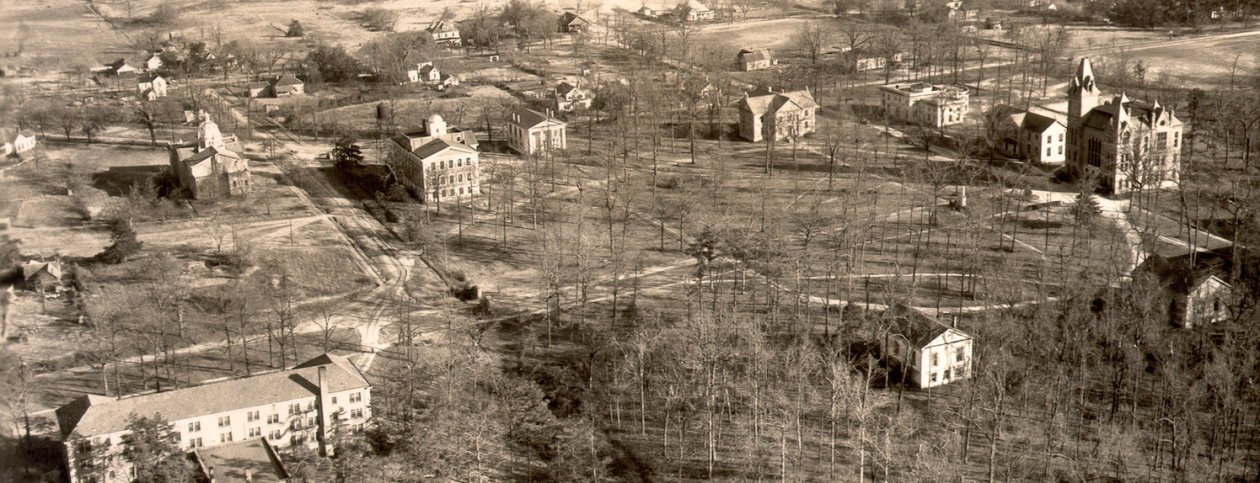
In a more rustic era, a variety of simple structures like the one below graced the Emory campus, lending the place an air of a Boy Scout camp or a Civilian Conservation Corps site. Notice the tracks running past it.

Screen Shot 2018-06-25 at 1.45.06 PM
Photo from Stuart A. Rose Manuscript, Archives, and Rare Book Library

I was reminded of this image a couple of weeks ago when Jim Morey, English professor and resident of Druid Hills, wrote to me with a question about something I had posted in a brief story about the original Druid Hills campus.  The map in that post is one I pulled as a screenshot from Google Maps. Jim noted the “Emory Trolley Line Substation” in that image and wondered whether that referred to the small brick building at the corner of Oxford Road and Eagle Row. You can see that notation on the map below.

Screen Shot 2018-06-25 at 1.55.56 PM

There is, indeed, a Georgia Power substation on that corner, and aerial photos suggest that the small red-brick building in that area dates from the late 1940s, while the high brick wall behind it, surrounding the large steel structure and high-tension wires of the substation, may be a somewhat later construction, or may have been enlarged as the demand for power in the neighborhood increased.

Screen Shot 2018-06-25 at 3.08.01 PM

It’s interesting but odd that Google Maps would identify that space with the Emory trolley!

It’s true that until about 1947, a trolley ran from Briarcliff Road along the Byway to Oxford Road and then to a stop near the Emory Village intersection. There — at about where Chipotle and Romeo’s Pizza now share a building — the trolley reversed direction and returned to Atlanta (this was long before Emory was officially part of the city). The route appears as a red line in the map below.

Screen Shot 2018-06-25 at 2.14.07 PM

The location of the little shelter at the trolley stop also appears on a campus map from 1940-41, below.

1940-41 map

That trolley stopped running in 1947 — coincidentally, the same year that Gilbert and Thompson residence halls were constructed near that corner. Perhaps the small brick structure for the substation went up at the same time.

It’s fascinating to imagine that recent decisions by Atlanta, MARTA, and Emory might one day bring back to Emory light rail reminiscent of the trolley. But the log cabin likely will remain a thing of the past.

Gary Hauk

Taking the trolley to Dobbs?

I recently came across a photo in Rose Library that made me wonder whether a trolley once ran through the Emory campus, although that seems farfetched, and nothing I’ve read or heard has ever suggested it.

Dobbs Hall, named for donor and trustee Samuel Candler Dobbs, a nephew of Asa Candler Sr., originally housed theology and law students when it opened in 1916 as one of the first two residence halls on the Druid Hills campus. The building — made for student life before radio, let alone television, stereos, hair-dryers, coffee makers, microwave ovens, mini-fridges, George Foreman grills, and computers with their accessory printers — still houses first-year students in Emory College, for whom the cramped shared rooms build “esprit de corps.”

In 1962, to accommodate a growing student body, Emory built a concrete addition, which you can see in the photo below. Taken last week, the photo is not great, but it offers the same perspective as the next photo, in black and white, which was taken perhaps in the 1930s or 1940s.

Dobbs Hall 2018

Screen Shot 2018-06-11 at 1.04.13 PM

The street going off to the right in the second photo is the current Dickey Drive, formerly called Pierce Drive until a realignment of streets in the early 2000s (named for earlier Emory presidents James E. Dickey and George Foster Pierce). The street going up to the left was formerly called Arkwright Drive and is now simply a sidewalk between Dobbs Hall and the Woodruff Physical Education Center and soccer field. (Preston Arkwright was an early 20th-century trustee and the first president of Georgia Power.)

What caught my attention in this photo is the overhead wires going up Arkwright Drive. They look like trolley wires, but they may be simply power lines serving nearby buildings.

Below is another photo of Dobbs Hall from roughly the same perspective in March 1960, two years before the addition of the back section of the building.

Screen Shot 2018-06-11 at 1.20.57 PM

I would love to hear from any former residents of the building who have stories about life in Dobbs.

Gary Hauk