Traffic circle redux

Note: This post has been updated. The original post indicated that planning for the current roundabout in Emory Village began just a few years before the roundabout was completed in 2011. An earlier plan, however, had been proposed by the Chace administration as part of the university’s comprehensive campus planning of the late 1990s.

Two decades ago, during the administration of Emory president Bill Chace, the university worked with campus planners and traffic consultants to design a new intersection at the front gate of the university. A recommendation went forward to DeKalb County to replace the traffic light at the five-point intersection with a roundabout. More than a decade passed before the county and businesses in Emory Village saw the wisdom of the recommendation. In 2011, the county completed the current roundabout, and along the way Emory enhanced the Haygood-Hopkins Gate with a sweeping pair of marble walls to create a grand entrance to the campus.

It turns out, oddly enough, that this concept was already half a century old when the roundabout opened, although no one may have known it at the time.

Recently, as I looked through materials in the Campus Buildings and Landmarks Collection in the university archives, I came across three drawings created in 1960. No documents or explanation accompanied the drawings, so I can’t say what the intention was behind them. Did the administration seriously contemplate an imposing new front door to the campus? Was this design merely a suggestion from an interested landscape architect? Did other plans take precedence, leaving these renderings to be forgotten?

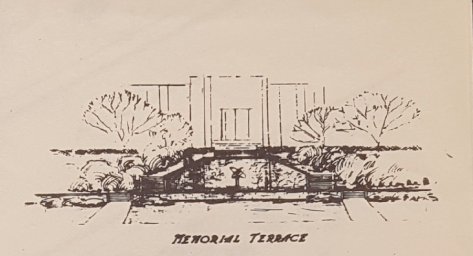
What strikes me about the first drawing, below, is the plan for a building where the Boisfeuillet Jones Center would be constructed a quarter-century later. To the west of that “future building,” the architect suggested a memorial terrace in the space now occupied by the Oxford Road Building and its parking deck.

20180813_162135
From Stuart A. Rose Manuscript, Archives, and Rare Book Library

Here’s a close-up the west elevation of the memorial terrace, as if from Oxford Road:
Screen Shot 2018-08-17 at 9.37.37 AM

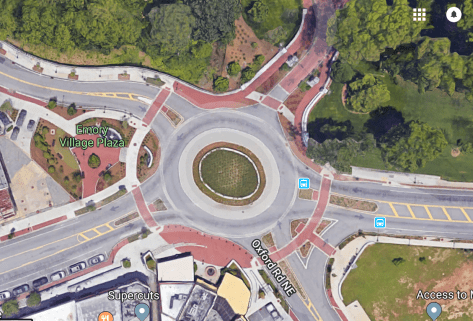
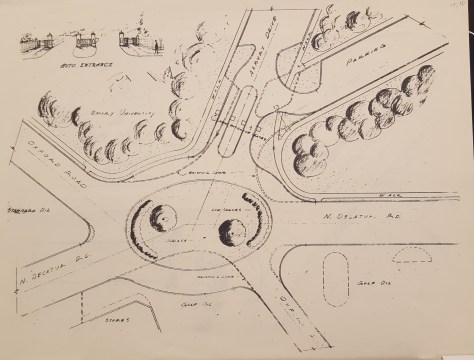
More striking is the proposal for a traffic circle and a monumental “auto entrance” to the campus, shown below. The siting of the roundabout almost exactly matches the contours of the 2011 roundabout. It’s unclear from the sketch in the upper-left corner whether the Haygood-Hopkins Gate would have been retained as the central pillars of the two-way auto entrance, but the 2011 solution–which made the entrance one-way through the Haygood-Hopkins arch–works fine.20180813_162246
Screen Shot 2018-08-17 at 10.44.47 AM
Emory Village roundabout, satellite view from Google Maps.

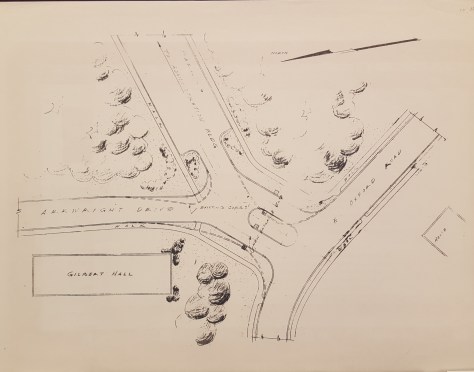
The third rendering, below, shows a similar but somewhat less grand entrance to the campus off Oxford Road, near the old Gilbert Hall. The university razed Gilbert (and its neighbor, Thomson Hall) in 2007 to realign the streets at that entrance and make room for the Psychology and Interdisciplinary Sciences Building.
20180813_162340

Someone in 1960 was thinking about making the campus more elegant. Unfortunately, succeeding decades would take the campus in a different direction, adding Brutalist-style architecture and impeded traffic patterns around the campus. It would take until the Chace administration — nearly four decades after these drawings were completed — before the university would begin attending to its built-up space with a similar concern for the stylish look and graceful flow of open spaces.

Gary Hauk
Emory’s religious pilgrimage

When I was a freshman at Lehigh University, more years ago than I care to admit, my fellow frosh and I took a survey that the Cooperative Institutional Research Program (CIRP) has been administering to first-year students since 1966. It’s a useful tool for studying how students at American colleges and universities have changed over the decades — not only in terms of income levels, ethnic and racial backgrounds, and similar measurements, but also in terms of attitudes, aspirations, and aptitudes.

Among the dozens of questions, the survey always includes one about religious preference. My only recollection about my freshman class in this regard is that one student checked the box beside “Other” and wrote in “Druid — Reformed.”

I’ve been thinking of this in light of Emory’s United Methodist affiliation and the latest data on religious affiliation of Emory students.

The Methodist trustees who wrote the University bylaws in 1915 said that Emory “was founded . . . for the promotion of the broadest intellectual culture in harmony with the democratic institutions of our country and permeated by the principles and influences of the Christian religion. It is designed to be a profoundly religious institution without being narrowly sectarian. It proposes to encourage freedom of thought as liberal as the limitations of truth.”

Such language neatly fit the vision of John and Charles Wesley, who sought to blend “knowledge and vital piety.” Methodism launched scores of colleges in the United States out of a faith that education would improve the soul as well as the mind.

In many ways, of course, the founders in 1915 understood our “democratic institutions” differently than we do today. Jim Crow laws still prevailed in the South, and women would not have the right to vote in federal elections for another twenty years.

Similarly, what it means to be “profoundly religious . . . without being narrowly sectarian” has changed. In those days, it meant that this Methodist university would admit students without regard to whether they were Presbyterian, Baptist, Episcopalian, or even Catholic or Jewish. It would be a long time, however, before the Emory Christian Association, formed by students in the 1930s, would be renamed the Emory Religious Association to reflect the growing religious diversity of the university.

Nowadays, a very vibrant interfaith program run by the Office of Spiritual and Religious Life brings together students from dozens of religious persuasions. Cannon Chapel is the scene of Muslim Jumah prayers on Friday afternoons, Jewish observances on high holy days, Catholic masses on Sunday mornings and evenings, and ecumenical Protestant worship.

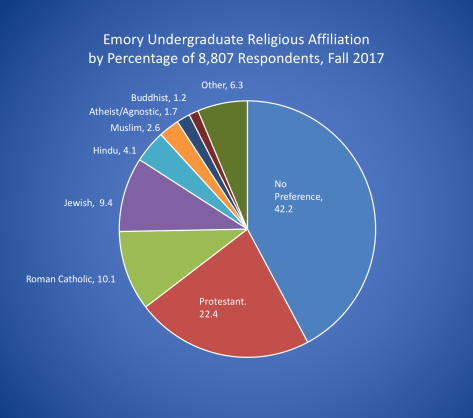
The latest data for Emory undergraduates — from the fall of 2017 — indicate that Methodism no longer outnumbers other religions on campus, and in fact Methodist students are not even the most numerous among Protestant Christians. The chart below tells the story.

Screen Shot 2018-07-31 at 4.38.39 PM

As matters of religious conviction continue to infuse our national and international politics and determine the worldviews of most of the world’s people, it’s a fair question to ask whether Emory continues to present itself as a place of scholarship and inquiry where the study and practice of religion also matter. Emory is not a Methodist Notre Dame or Georgetown or Brandeis, where the institution’s religious identity is as well known as its scholarship and teaching.

Still, the Candler School of Theology (the world’s largest United Methodist seminary), the groundbreaking Center for the Study of Law and Religion, and pioneering efforts like the Interfaith Health Program in the Rollins School of Public Health and the Journeys of Reconciliation sponsored by the Office of Spiritual and Religious Life go a long way toward that blend of scholarship and faith imagined by Emory’s founders.

The most recent CIRP survey turned up no sign of Reformed Druids at Emory, but I plan to keep my eye out. One is likely to be along any time, and I suspect that I’ll have much to learn in our conversation.

Gary Hauk