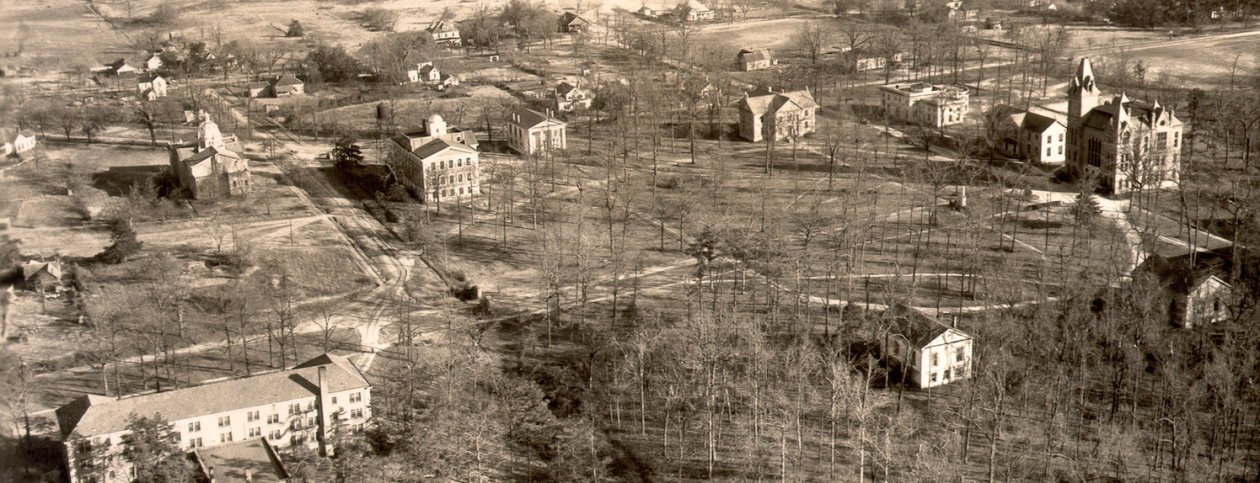
Prompted by the protests and arrests on the Emory Quadrangle in April 2024, the Interdisciplinary Workshop in Colonial and Postcolonial Studies this autumn presented a series of monthly seminars on “The University and Democracy.” The series intended to explore three questions: What is a university? Who makes up the university? What do recent developments at Emory tell us about the challenge to democracy—in academia and beyond?
The first seminar focused on “the idea of the university,” especially since the rise of the research university in the nineteenth century and its flourishing in the United States. The second seminar focused on protests at U.S. campuses, especially those in the spring of 2024 at dozens of colleges and universities.
For the third seminar, on November 14, 2024, I was invited to join a panel to share the history of specific protests at Emory over the past sixty years. I spoke about a race-related protest in 1969, while Professor Emerita Bobbi Patterson related her engagement with protests for LGBTQ rights in the early 1990s, Professor Jonathan Prude talked about protests regarding labor practices in 2010-2011, and Professor Pamela Sculley addressed some of the implications of last spring’s protests regarding the war in Gaza.
The text of my presentation follows.
I begin with the proposition that all of the protests at Emory University since the 1960s have implicitly or explicitly raised the three questions that have shaped this seminar series: First, who belongs in this community? Second, are some members of this community second- or third-class members who lack the full privileges of the community? Third, what is the appropriate forum or process for making decisions that affect all members of the community and even the nature of the community itself?
My understanding of the history of Emory since World War II tells me that all of these questions have been at play in the protests about race in the 1960s, about women’s safety and opportunities in the early 1990s, about gay, lesbian, and queer rights somewhat later in the 1990s, and about class and labor in the 2010s. My specific charge for this panel, however, is to focus on the protest of May 1969 led by the nascent Black Student Alliance. First let me give a little background.
Melissa F. Kean, a historian now retired from Rice University, has written the definitive history of the desegregation of private higher education in the South, focusing on Duke, Emory, Rice, Tulane, and Vanderbilt [Melissa F. Kean, Desegregating Private Higher Education in the South (LSU Press, 2008)]. The story at Emory is one of complex negotiations throughout the 1950s, as Emory was hemmed in by Georgia Jim Crow laws and a conservative board, on one hand, while on the other hand Emory faculty and students, the Methodist Church, and even the administration’s own ambitions for national eminence pushed against the status quo.
The story is too involved to share here, but my reading of it is that while desegregation was a long time in coming, and while external pressures of federal law and federal funding influenced the outcome, the eventual decision to sue the state of Georgia for the right to integrate was the result of shared governance, in which faculty persistence, student voices, a few enlightened administrators, and a changing board joined in a not-always-smooth process of determining to move the university into a new era. They had confronted the first of our three questions, namely, who belongs in our community, and they had answered that African Americans belonged in a way that they had not. They were no longer to serve only as groundskeepers and laundry workers, janitors and food-service workers. They were to be students as well. That new era began in 1962, when the Georgia Supreme Court struck down the prohibitive law that Emory had sued to overturn.
Go forward seven years to 1969, however, and despite the admission of African American students, life on this predominantly white campus was not easy for them. They were few in number, and there were no Black faculty members in the College and no Black administrators. In March of that year, the newly formed Black Student Alliance sent President Sanford Atwood a list of proposals for enhancing the Black student experience. They requested more deliberate recruitment of Black students; funds for an orientation program for newly admitted Black students; a house or other facility dedicated for use by Black students; a Black adviser; an African American studies program; more Black faculty; and more library resources devoted to Black culture, history, and experience.
The president’s response was somewhat tepid, even defensive. And while the president invited the Black students to engage collaboratively in effecting change, his response was marked by signposts to the complex bureaucratic minefields that students would have to navigate to get any real satisfaction.
Unsatisfied, on May 25th Black students interrupted the Sunday morning worship service in the university chapel, which at that time was in what is now called Convocation Hall. With placards and voices, they called out what they viewed as the institutional racism that still persisted at Emory. From the chapel the thirty-five or so students marched to Cox Hall, where they distributed flyers calling for a boycott of the cafeteria, which at that time served the hospital as well as the university. The protesters cited racist employee regulations and substandard wages for the cafeteria workers, who were earning only a penny more than the federal minimum wage of $1.30—hardly a living wage even in 1969.
Throughout that Sunday, the original protesters were joined by others, including white students and some white faculty and staff members. Photos of the incident show a stand-off between the protesters and what appear to be one or two administrators. According to reports in the Emory Wheel, the protesters maintained a picket line but did not prevent people from entering the cafeteria.
On Monday the 26th, the BSA held an evening rally on the Quad, in front of Candler Library, that attracted about five hundred persons. Black student leaders who spoke would later constitute a who’s who of Black Emory alumni: Hank Ambrose, now a retired DC lawyer and former Emory Alumni Board member; Larry Palmer, who entered the U.S. Foreign Service and distinguished himself as an ambassador to several countries; and James Gavin, who became a national expert on diabetes and chaired Michelle Obama’s task force against childhood obesity as well as serving as an Emory trustee. After listening to the series of speakers, the crowd dispersed without any resolution or sense of next steps.
The next day, Tuesday, two Emory presidents addressed the tensions in diametrically different ways. Charles Haynes, who was only a sophomore but had been elected president of the Student Government Association, called a special meeting of the SGA to discuss the BSA demands. He and his fellow SGA executives made clear that they wanted to de-escalate the tensions but also find ways to fund and support the BSA proposals, which they considered reasonable.
On the other hand, President Atwood sought and received a restraining order from DeKalb County Superior Court prohibiting protesters from blocking Cox Hall or the entrance to the campus; from disrupting the peaceful operation of the university; and from occupying university buildings. President Atwood was prepared to have students arrested if it came to that.
What happened next sounds legendary but is the truth and should be part of the historical knowledge of every Emory person. You can read about it online in the autumn 2005 issue of Emory Magazine, where Charles Haynes tells the story. In short, young Charles—just a sophomore, remember—went alone late at night to Lullwater, the university president’s home, and knocked on the door. He was greeted by President Atwood, who stood, as Charles tells it, in his bathrobe. Atwood invited Charles inside, and the two had a long conversation about what was happening. When Atwood admitted that racism did exist at Emory, Haynes sensed that a way forward had opened up.
The two presidents drafted a statement that Atwood read at a convocation which had been called by the BSA for the next day, Wednesday, the 28th. In Glenn Memorial, Atwood recognized publicly the existence of institutional racism at Emory and pledged the administration’s efforts to dismantle it and implement the BSA proposals.
Out of this protest and the university’s response came the creation of the first Black studies program at a private Southern university; the hiring of the first tenure-track African American faculty member in Emory College, Delores Aldridge; the establishment of the BSA House; the hiring of the first Black administrator, Marvin Arrington; ramped-up recruitment of Black students; and President Atwood’s creation of the President’s Commission on the Status of Minorities.
It’s important to note that while some faculty applauded the BSA proposals, some of the more senior and distinguished faculty members in Emory College decried the protests and the administration’s accommodation to the students’ demands. All of these things were, in the view of some faculty, a threat to academic integrity, which should be determined and safeguarded by the faculty. (One senior member of the Chemistry Department, for instance, noted that the proposal for a Black studies program had not yet come before the Curriculum Committee of the College.)
It’s also important to note that some Emory staff members put their careers at risk in objecting to Atwood’s heavy-handedness. One of them was Jerome Zeller—Jerry Zeller—who was an Emory alumnus, Episcopal priest, professor, and dean of students. The day after the administration obtained a restraining order, Zeller wrote a memo to Atwood, and I quote part of it here:
It is my opinion . . . that to serve the restraining order on students . . . will mark the end of reason and destroy a valuable dialogue which is now beginning to take place.
You have offered the life of this academic community to off-campus authorities, and have offended those who have worked to keep Emory a real community. Through your action the University is no longer a responsible agency for reconciliation.
You now proceed fully against my personal principles and my professional advice.
So here we see the beginning of an answer to the third question in front of us. Who gets to decide about matters that affect the whole community? It cannot be only the administration, only the faculty, only the students, and certainly not authorities from beyond the campus. It must be the community as a whole, in some kind of open forum, through argument and debate.
I want to conclude by addressing another question that has animated this seminar series: what is a university? Our friend and colleague Silas Allard, who attended the first two seminars in this series but is dutifully teaching a class today, has suggested that the history of the university as a locus of protest since the mid-twentieth century perhaps points to the reality that protest is not a disruption of the university’s mission but is, rather, central to what a university is all about. Universities are in many ways conservative institutions. But if we think of the way scholars are always wanting to revise each other’s work, always raising questions about the validity of arguments, and regularly upending the status quo, then yes, protest seems to reside in the very DNA of the university and must be welcomed. Challenging received wisdom is part of what defines the university as an institution and, more, as a community.
Addendum:
That concept of the university as a community was important to the identity of Emory for most of my thirty-five year career at Emory, beginning during the presidency of Jim Laney. In fact, the concept was clearly articulated in the annual report of the president for 1991, which I drafted as secretary of the university.
In early 1990 a series of sexual assaults (two in fraternities and one at a secluded part of Lullwater Preserve) prompted campus activism in behalf of greater campus security and more prominent resources for support of women. President Laney appointed a twenty-five-member committee called the Task Force on Security and Responsibility, which had an eight-point charge, including “sensitivity to gender and ethnic diversity.” Working quickly, in two months the task force issued a report with twenty-four recommendations, including the creation of a women’s center. All of those recommendations would be implemented in time.
Reflecting later on the tumult of that year, the Annual Report of the President, published in Campus Report on January 28, 1991, summarized the transformation that the protests of the previous spring had set in motion:
All of this discussion showed, among other things, that a University must find appropriate ways to air and deal with conflict. We learned not that the fabric of our common life was in danger of being rent by discord or suspicion, but that the warp and woof of our tapestry was strong. . . . Emory can hold safely in its midst the conflicts typical of close-knit communities. What is more, Emory can transcend these conflicts in creative ways. In a society as pluralistic as the America of the late-twentieth century, we can expect more such tests. American universities must explore new avenues for defining and resolving conflict, and Emory means to lead in this endeavor.
Unfortunately, the three decades since those sentiments were published have wrought a further transformation of Emory that makes the exploration of those “new avenues” more difficult. The institution is larger, more complex, more top-heavy with administration, more subject to the social and financial pressures of parents, students, donors, and government oversight. The sense of community (whose weakening was already felt in 1991 by some faculty members who had been around for several decades) has eroded further as the demands on faculty time have multiplied, and as the focus on corporate leadership skills supersedes fostering the old ideal of a “community of scholars.” (However at odds with each other those old scholars might sometimes have been, their priorities of teaching and scholarship included discourse.) Nevertheless, our polarized society more than ever needs methods for holding community together while debating the fundamentals by which we live. Universities, more than most institutions, may be uniquely situated to serve as laboratories for creating those methods.
 Emory Historian's Blog
Fine piece of work, Gary. Hope all is well with you and Sara.
LikeLike
Hi Gary, thanks for sharing this with me. Now and again I ponder about the Emory situation and the ghastly situation in Israel. I hope Greg is now out of the woods and is more happily engaged and profitably engaged with both the faculty and the concerned students. As I look back to the years in which we were together working through the problems of the University, I sense that perhaps we were in the hands of a more protective and kindly presence. Worldly realities did not then seem as close nor as dangerous.
I trust that Sara is now much more ambulatory and that any traces of atrial hippity-hop are absent from your daily schedule. And I look forward to reading the memoir you are composing. We know now, don’t we, about loss? It never goes away, and on occasion it returns with terrible power.
From sheltered Northern California…
Bill
LikeLike